All posts by stewart135

Hannah’s 9th Birthday – Manihi’s and the S Pass, Fakarava

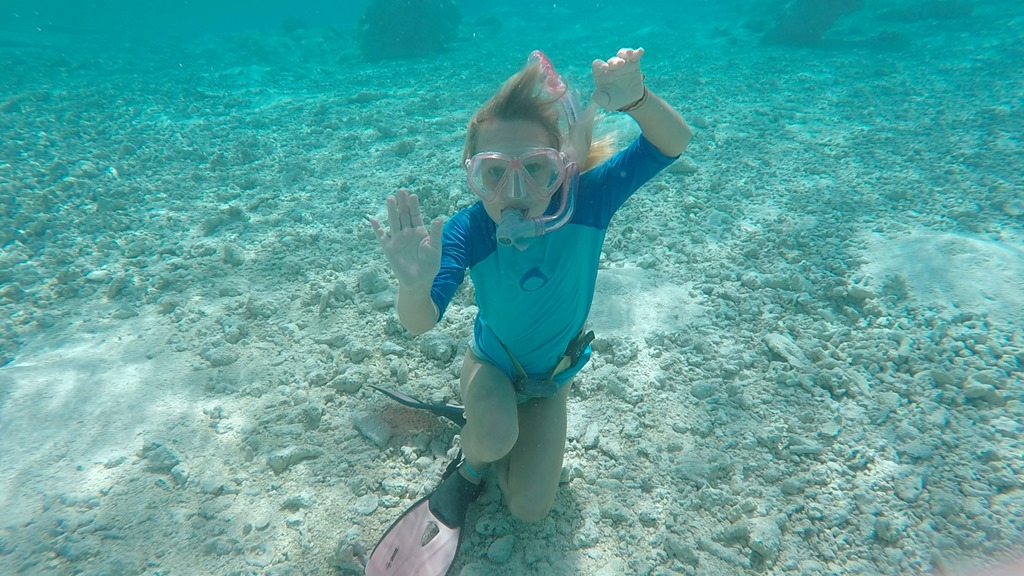
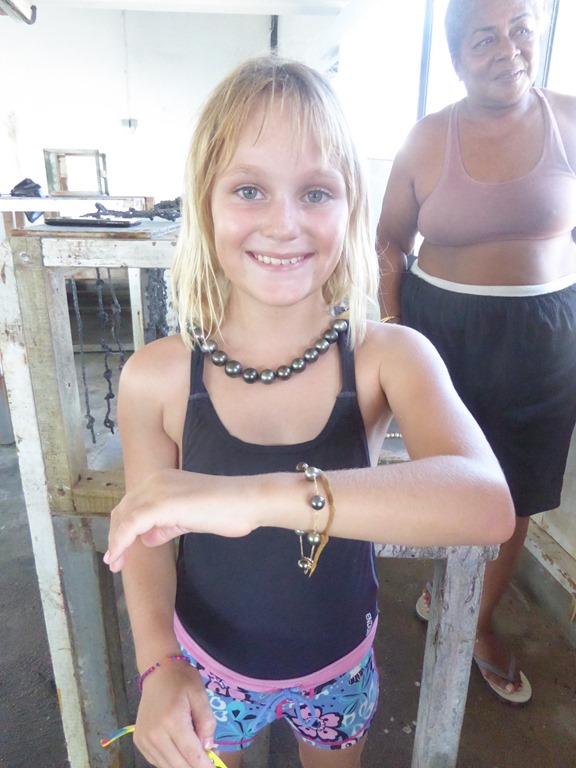
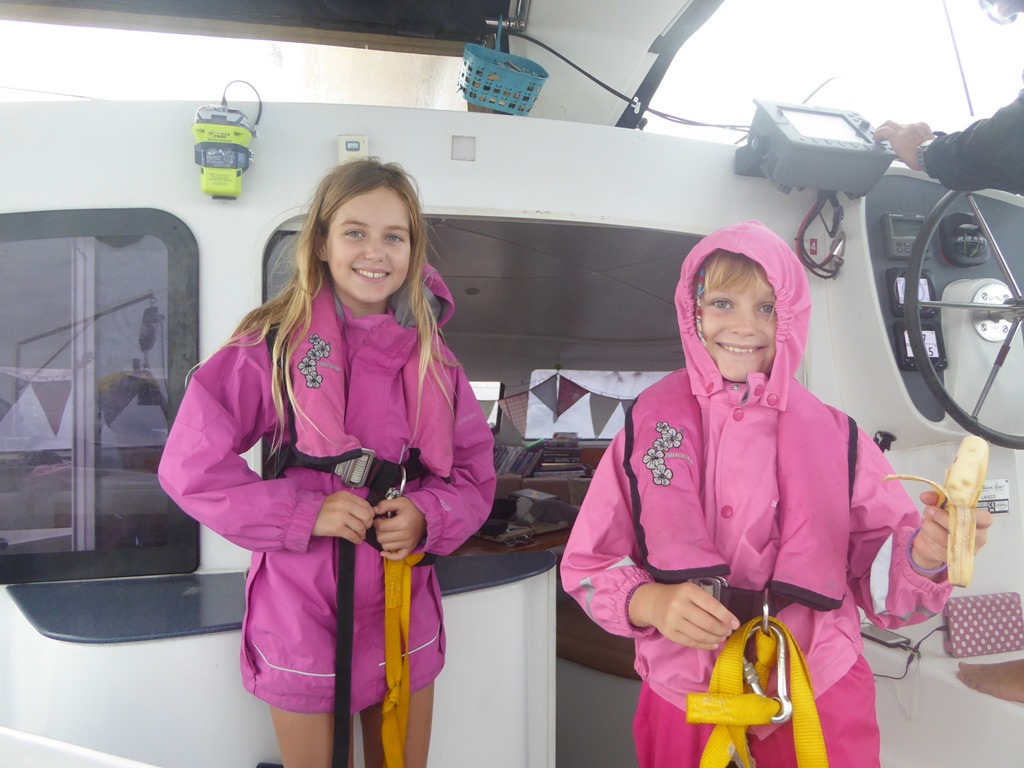
H's birthdayWe have had some exotic birthday locations this past year. Lou’s was on passage between Barbuda and Sint Maarten. Eleanor’s was celebrated on passage half way along the S side of Haiti heading for Cuba. Mine was at the S end of Makemo. Hannah, living up to the requirement for another memorable place was held at the S pass of Fakarava.

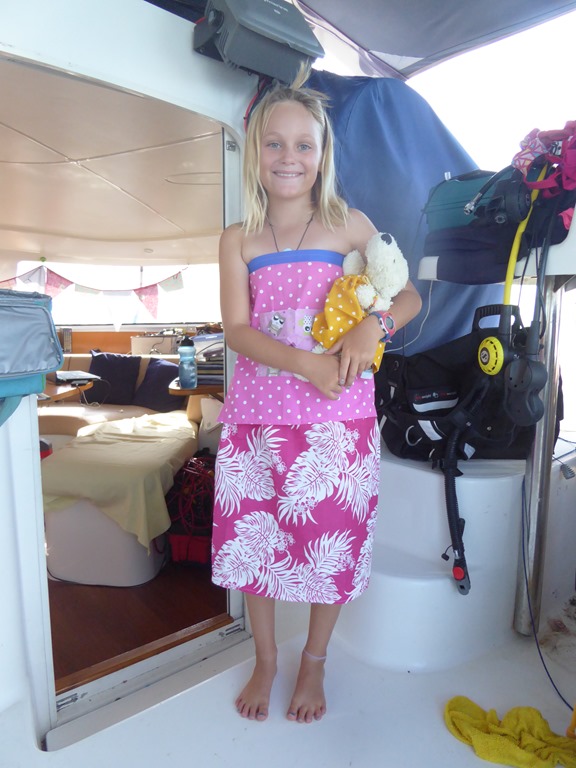
Someone had to be sent back to bed at 0500hrs as they were a little overexcited. However, at a still early but reasonably civilised time, presents were opened on board. Hannah did particularly well out of Eleanor’s burgeoning craft skills. The gift cards promising to give unargued choice of films for film night and free bed making went down as well as the skirts (for Hannah and Snowy), cooking apron and a variety of necklaces and bracelets.  A great addition to the gift pile was a bag of balloons from Julia and John and the girls had a lovely time decorating them with pictures and birthday messages, putting them up around Skylark. Party blowers provided plenty of noise. Julia had also produced a beautifully crocheted crab (dutifully named Cedric) to add to the crocheted sea life collection that Julia had worked on during a productive crafty afternoon. 


H's birthdayP1050479

There was a special breakfast of pancakes. Unfortunately our last kilo of flour, bought and held back for the task in Rotoava before we came S, turned out to be inhabited by a few too many weevils for Lou’s liking! The day was saved by Mary Ann II and Taranga who both managed to supply some flour which did the job for both the pancakes and then a birthday cake, ably iced by a somewhat sticky Eleanor. Our thanks to both yachts.

We had a lovely snorkel through the pass, roared through by a strong current and then a little play on Skylark. The afternoon brought Taranga, Mary Ann II and our neighbours, Ocean Star on board for a birthday tea and cake. The food collection was impressive with cookies, cake, biscuits and a huge pot of macaroni cheese from Mary Ann II, which all went down extremely well. We even got everyone, a la Officers’ Mess traditions, to sign in the Visitors book. Good memories!

H's birthday

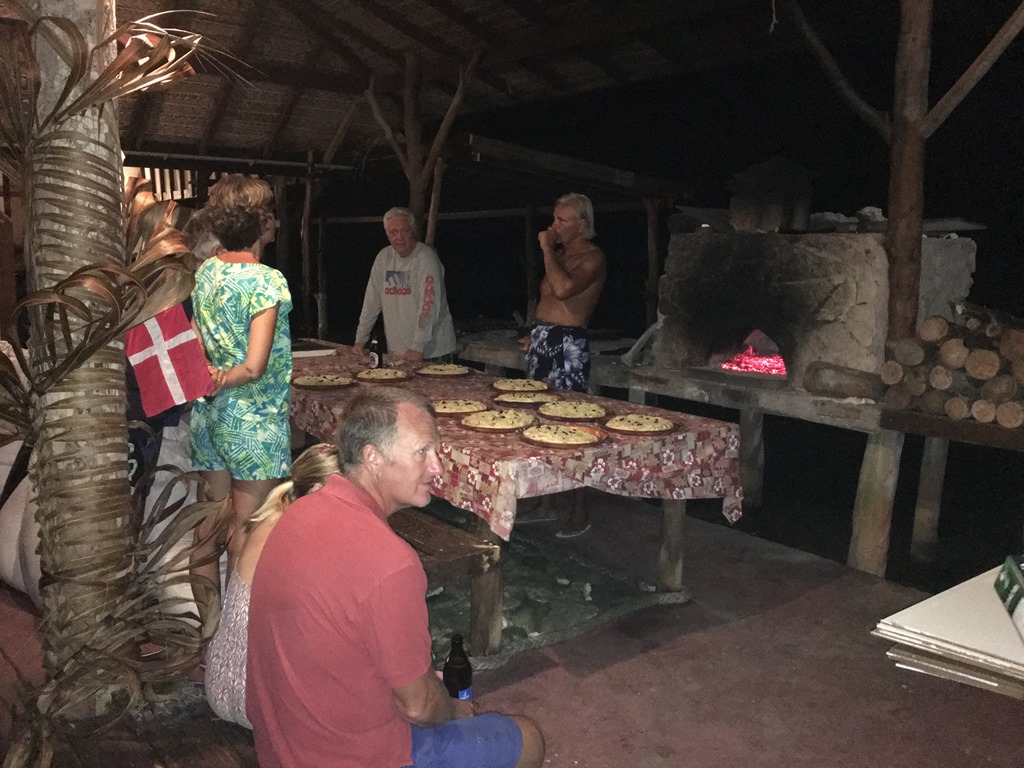
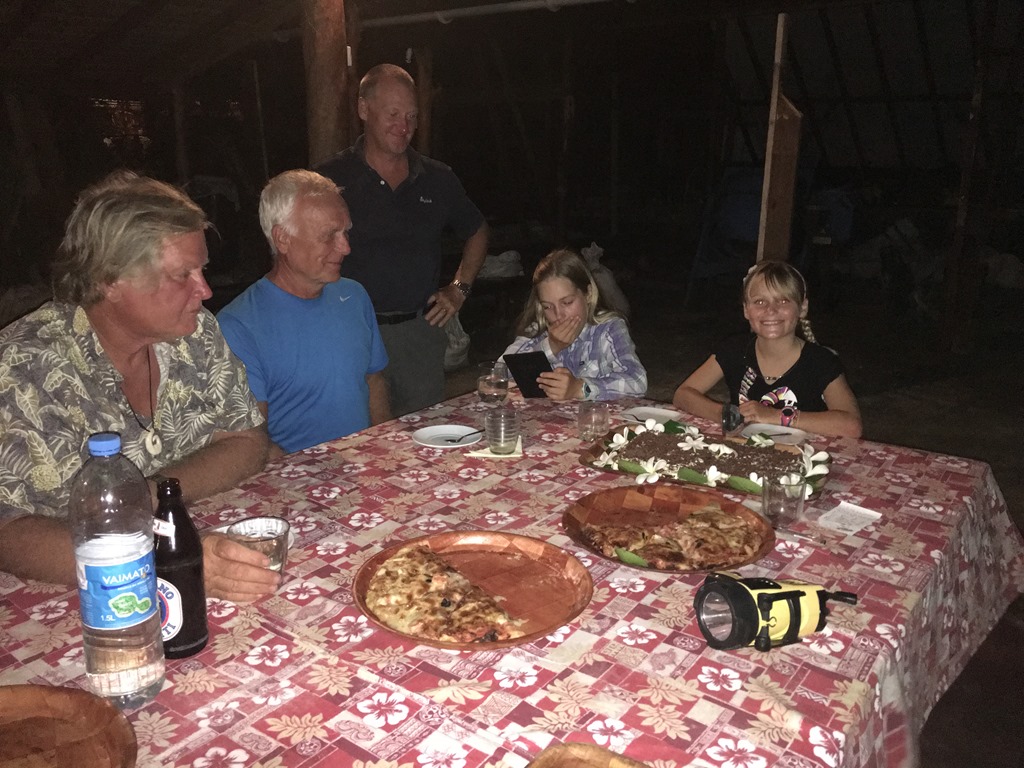
We had to wait for a day to have a birthday dinner at Manihi’s as he was full of guests on Hannah’s birthday. However, the homemade baked pizza were worth waiting for, the company was great and our thanks to Manihi for the pineapple cake covered with icing and decorated with flowers. The Taranga crowd sang a Danish birthday song – Hannah was a little suspicious about what they were actually saying – which was again greatly appreciated. Hannah came home happy and exhausted.

H's BirthdayH's birthday


Our next birthday to celebrate is Lou’s which will be in New Zealand. We had better get planning but I’m already thinking Yorkshire puds, fresh veg and gravy need to figure…….. Smile


H's birthday

By the Light of the Silvery Moon

By the light of the Silvery MoonA while ago I wrote a piece on working out the tides around the Tuamotus, specifically in regard to what you would find around the passes of the atolls where I said that I would be looking at a lunar model suggested in the British Admiralty Pilot from 1969 I have on board. I haven’t yet but still intend to have a decent look. Let’s just say I’ve been collecting evidence.

I had finished diving the N pass with Top Dive, one of the companies based in Fakarava (thoroughly recommended BTW), heading back in and I ended up in conversation with Mano,  a local Dive Master, instructor and all round good guy, who has been working for dive schools for 10 years. It was his turn to be driver that day so I stood at the bow with him as he expertly guided us through the chop back towards Rotoava. I asked him how the school judged the dive times they used. By way of explanation, the school will generally do two pass dives a day using the incoming stream only. An outgoing current is dangerous as the current dives strongly at the ocean wall drop off, which can quickly take any diver foolish enough to be subsurface there down to lethal depths in a matter of seconds.

His answer surprised me. “The Moon”  with a nod of his head. Pointing with one hand, “ when the moon is there,  then the tide is high, when it is there, then it is slack, there, then incoming and there, outgoing.

He told me all the local fishermen used the same system as they also knew by the moon’s position when the best fishing was to be had too.

This method had been taught to him as a boy in Tahiti by his Grandfather and he had always found it accurate enough for his years fishing and in the diving industry. I also queried him on the more modern method of tide tables. He just smiled.

“The moon is always there. All you need to know is how to read it”

Don’t you just love technology?

More practise required by this callsign……..


BTLOTSM

Fakarava – Arrival and the North End

I remember Dad arriving back from a very rare weekend of racing on Sulas Wing, his old wooden 25’ 5 ton Bermudan sloop. She was a lovely thing but needed a gale of wind to really get up any pace. The race was between  Ardfern and Croabh. The timing for the race start must have been a bit cocked up as the fleet ran straight into the opposing tide at the Dorus Mor and sat there tacking back and forward going nowhere fast. With a bit more local knowledge, Dad stayed within throwing distance of the N shore under the tide, crawled around the point and ran away from the fleet, winning by a huge margin to the disgust of the “professional” racers. The next day, with a lot less wind and the right tide, the racy crowd left Dad standing. He came home with a cup for his win and a mounted toilet seat for being the last boat in on the return. I have always had a sneaking suspicion he was far prouder of the Seat than he was of the tiny nearly silver cup!

After a fast sail across from Kauehi, blown along by 20-25kt winds, we arrived at the N pass to Fakarava very early. We could see the race on the W side of the pass but it all seemed very flat on the East side. I decided to try one of the little gems of knowledge thrown out by the British Admiralty Pilot book I spoke about in “The Vagaries of Tuamotus Tide” a couple of blogs ago. It says

“The prevailing winds being easterly; the outgoing tidal stream being always deflected slightly westward of the entrance of the pass; and probably due to the the effect of wind and tidal stream, there being always more danger on the western side, it is advisable to approach and enter the pass very slightly eastward of its axis. There is usually a race……….and by approaching slightly eastward of the axis of the pass, the vessel will be able to skirt its eastern edge”

It doesn’t suggest anything like this in any of my other guides but it had reminded me of Dad’s cheeky shore hugging manoeuvre. According to our Guestimator, we should have had 2-3 knots against us and needed to wait for two hours for slack. In the end we stuck our noses in, stayed within 25m of the reef on the eastern side and got no current at all until we were more than half way into the pass. Up the Admiralty – again! We punched about 2kts for 2-300m and then were through. No standing waves and no trouble. The outward race screamed on with white horses and big standing waves, 500m to our W……. Lesson learnt. Trust your eyes, listen to old knowledge and look for local variations at the passes.

Fakarava

We motored five miles into the wind back E in to the deep anchorage of the village of Rotoava, the main town on this atoll. We had been told on the morning net that the community had started to put in mooring balls to protect the coral and we found two of the seven balls unoccupied. It was nice to pick one up, our first since Jamaica, and even better,  they are free. The community installed 17 balls in the atoll in Dec 15, all rated to 30 tons, and plan more once finances are raised. I think it is a great idea. The number of yachts that parked off the village during the high season exceeded 100 this year and the locals, whose livelihood is the biosphere of their atoll, know they must protect what they have. According to the dive school that helps service them, they are not intending to charge for them. Time will tell. Their locations are below.

 Fakarava 

The village of Rotoava is chalk and cheese from Kauehi. In our first week, we have had two cruise ships, the Aranui V and the small freezer container ship visit plus lots of planes. We even had a helicopter buzz us from Dragonfly, a 82m superyacht owned by two of the Google owners. The main supply ship comes in on Wednesday bi weekly. There are upmarket hotels as well as small pensions and even in the off season there are plenty of tourists around. There are three dive schools, all very well equipped, all wanting you to be NITROX qualified to allow them max dive time during the slack tide periods at the passes. There are restaurants, a pizza takeaway (someone’s house admittedly), two large stores, one which doubles as a boulangerie, pearl shops with right posh offerings, several artisan shops for the tourists and a very well appointed church. Yup, there is money here.

The only downside is that the local kids see too many tourists travelling through and unlike the other quieter atolls where they are wonderfully keen to welcome in boat kids, they are a lot more standoffish. We have had a couple of disappointed faces when ours have tried to mix in.

I’ve got myself locally NITROX qualified and in the process, rewrote the English NITROX hand out guide for the dive school to replace the awful text they were using. I’d done two drift dives through the N pass – very good and was planning more with the school but then, good news! Soren and Taranga arrived after a bit of a bashing up from Tahiti. We hadn’t seen him since the Galapagos although Mia, part of his crew to cross the Pacific, had joined us from Taranga in the Marquesas. It was great to see him and his new crew, all divers and with a compressor on board, a plan was hatched to pair up, dive together and for us to help with the safety boat and provide him with water.  I’ve done a separate blog to cover the diving. Lots of photos!

At the S end of the village, there is Fakarava Yacht Services run by Stephanie and her husband. Lou has been using their porch for internet, a good chat and a great source of information on what’s going on around the village. They can also fill gas bottles (European and US fittings) at 500XFP a kilo. Petrol and diesel can be had from them, very expensively, at 200XFP a litre which frankly is a rude mark up of 50% from the price you can order it from the weekly ferry (130xfp A L) . As a comparison, Makemo was 165 and 170XFP – wish I had bought there….. Stephanie can supply local free range eggs at 1000 a tray of 20. They are the best eggs we have had in a long while. The Taranga crowd hired bikes from them at about 1500XFP a day to explore the island.

Fakarava

One of our favourite places to hang out has been the “pink slushy bar”, 500m S of the Catholic church, otherwise known as La Paillote. It is small, has its own jetty, generally inhabited by yachties with the very occasional tourist, has internet, offers snacks and best of all, ice cold slushies of such foulness as bubblegum and watermelon flavour. The blue bubblegum, a Hannah favourite, is guaranteed to turn your mouth a vivid blue. The cafe is also home to a very competent fisherman who appears daily with enormous Mahi that he has caught using a large spear, thrown whale hunter like from his fishing boat.  We have a great time watching the big Nurse sharks that come in to accept his offerings as he guts his catch. The small beach and coral heads off the bar are a pleasant place to enjoy life slowly going by and you get the same view as the guests in the hotel 100m down paying $1500 a week.

Fakarava

Fakarava

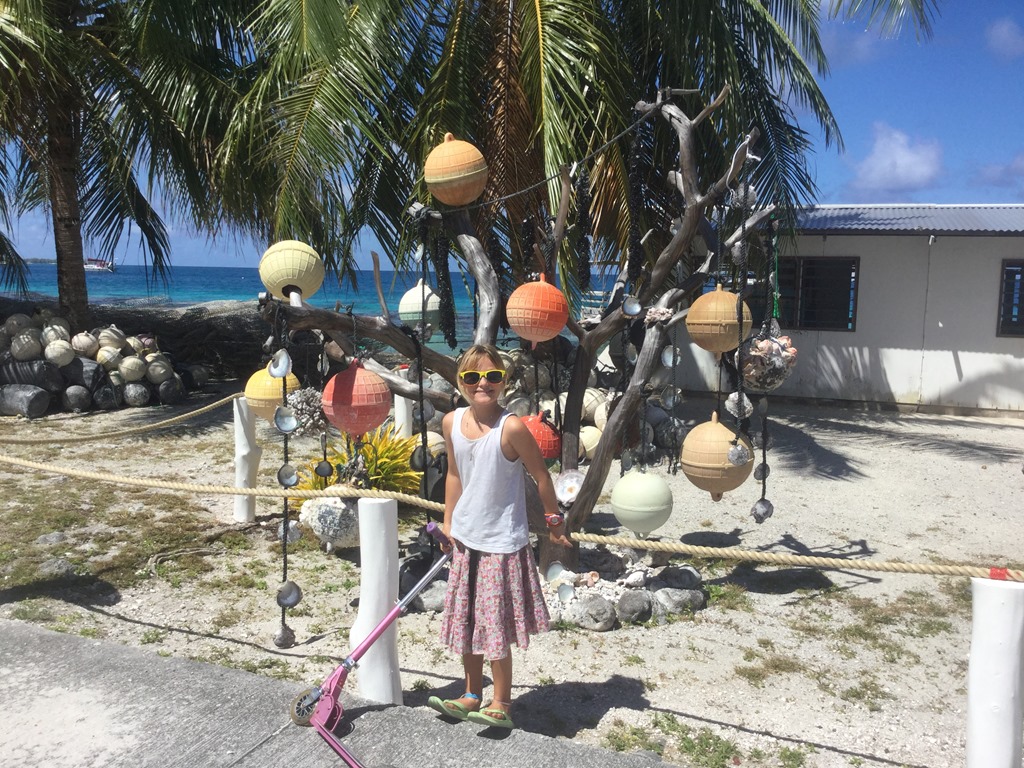
We have been doing a lot of school and music. Eleanor is charging on with the guitar and ever more turns out noise that is an approximation of music. Hannah’s maths is coming on great guns too. The tree decorations around the village are great fun. Some use floats from the pearl industry; some use old coral strung up with fishing line.

Fakarava

We have met another British couple for the first time in a couple of months. Mick and Kim, a lovely couple, on Phylis,  started in the US and are working their way W. We have been having a bit of trouble with our lights with the main board breaker shutting down the hull lights on both sides. Kim, who has a strong electrical background from the oil and gas industry, came across to offer help with a variety of multimeters, clamps and tools but sadly we were beaten by the French board connectors. Anyone really know how Wago connectors work?? We resorted to the internet and found a Chinese “how to” video which was very good. Sadly our breakers refused to perform as shown so we still don’t have hull lights.….

After a week or so enjoying the civilisation of Rotoava, we moved S with Taranga towards the S end of the atoll. Time to explore.

The Vagaries of Tuamotus Tides Or In Praise of Art

On board references used:

1.  Polynesia, Charlie’s Charts, 7th Ed

2.  The 2016 Tidal Guestimator, S/V Visions of Johanna

3.  Sailing Directions – Pacific Islands (Enroute), US Publication No 126, 2014

4.  Ocean Passages and Landfalls – Cruising Routes of the World, Imray, 2nd Ed

5.  The Pacific Crossing Guide, RCC Pilotage Foundation with the OCC, 2nd Ed

6.  South Pacific Anchorages, Warwick Clay, Imray, 2nd Ed

7.  The Tuamotus Compendium, S/V Soggy Paws

8.  Pacific Island Pilot Vol III, British Admiralty NP 62 ,9th Ed, 1969


This started as a quick bit of analysis for my own benefit after our entrance experience to Kauehi, listening to others talking about the difficulties of estimating slack around the atolls and the use of the Tidal Guestimator. It took on a life of its own. The more I read and looked up, the more I became sure that I wasn’t going to find how I could calculate a definitive answer. What I do now have is a far better understanding of why working out when slack tide is in the Tuamotus will always be an imperfect exercise, what the factors involved are and how I can get closest to an accurate answer. I know friends who sat scratching their heads for more than seven hours after what they thought would be slack water, watching the water rush out before finally being granted those elusive few minutes of quiet water to pass safely in to an atoll. I hope this missive will help them understand the circumstances that may have caused their delay and confusion. SH Sep 16.


All those that sail the coastal regions of the oceans are used to dealing with tides. Every few hours the tide turns and the sea runs in or out, generally by the rule of twelfths. Around the UK, we have wonderfully accurate tables and a full list of primary and secondary ports with nice graphs for tidal curves to work out what the tide will be doing to us at any particular moment in time. Our RYA test papers ask us to the minute when we will be able to cross the bar to enter harbour, which, with the accuracy of the data available to us, we can smugly do. Springs and neaps do complicate matters but our data deals with those.

There are a few tidal gates around the UK coast that we know that we have to hit if we want a quick and easy passage. Missing most of these gates will but inconvenience us a little, although those with West coast of Scotland experience might hold a stronger opinion!  I have found in conversations with other international cruisers that UK sailors are far less fearful of dealing with tidal problems, perhaps simply because we are exposed to more frequent and greater extremes than most. As prudent sailors, we are in the habit of looking at the tide tables before we leave harbour. But we can still be caught out. I remember fondly a trip with my father many years ago, delivering a boat to Ardfern, Scotland and ghosting along in very little wind,  being caught by the tide boiling past us just a few miles from our destination. I was astounded to feel the boat pirouette, completely out of our control, as the tidal front, whirlpools forming around us, grabbed us and spat us out. It was a salient lesson for a teenager on the power of the tide.

Here in the Pacific it is a bit different. For most of us sailing W in our crossing, the tide is of little interest. We look for current and any change to the normal Trade wind which will effect the wave pattern and size of seas we will experience. The current that runs most of the year E to W in a huge band S of the Equator can provide you with an excellent 0.5-2kts lift at times and this passes through the Tuamotus. 

Where tide is of interest is around the atolls, specifically when you are trying to enter or leave one. Each pass is a tidal gate. The best comparison I know of in UK waters is the pass at Cuan Sound on the West coast of Scotland where the tide flushes one way then reverses at high speed offering but a few minutes of slack for a slow moving yacht to transit, the rest of the tide being a white knuckled ride trying not to hit the Cleit Rock. The difference is the passes here are far more affected by wind and wave effects. 

After visiting our third atoll and listening to the daily dramas of others on the net, we are coming to the conclusion that working out when that elusive slack is going to happen involves at least as much art as science.

In its section on estimating slack water, Charlie’s Charts talks about using the NOAA tide charts then references another publication, Sailing Directions (Planning Guide), South Pacific Ocean (Appendix Atlas) that suggests that

“ the minimum current is most likely to occur one hour after Low tide and one hour after high tide as specified in the Tide Tables” but does not give a justification for this arbitrary fixed figure.  It also gives some other guidelines for individual passes, again in relation to a fixed time from a primary port. The other publications have the same problem. They want to give you guidance but are limited by the fact that any guidance they do give is likely to be inaccurate. So they stick to broad definitions which are worse than useless in my book as they give false confidence and cause confusion.

There are few primary ports here and the distance between where you are trying to work out your tides and where the primary is can run to hundreds of miles. The two closest to us at the moment are Rangiroa (160miles away) and Tahanea  (about 100 miles), neither exactly close. Not a problem, I hear you say. It should, if measurements have been taken over the years, simply be a case of adding or subtracting times to suit your atoll and Bob’s your uncle, there you have your slack times. Sadly not. It is not possible to be able to look at a tide table of an atoll and know exactly when slack is going to occur. The Tide Table is just the starting point.

A very popular tool, first released in 2011 and used by many cruisers here is called “The Tidal Guestimator”. Some go as far as to call it the “Confusimator” but I rather think that they have decided that slack calculations goes beyond art and into witchcraft. The Guestimator is an Excel spreadsheet that works out the slack tide timings based on a  +/- to the data from a single primary port, Rangiroa, one of the northern atolls and then adding in further corrections. Whilst it looks good, it is not a wholly accurate predictive tool as it requires you to guess/use art/estimate for one key bit of information which has a massive effect on the result you get out of it, hence its name. More on this later.

The big problem with the Tuamotos is that there are additional factors that can significantly alter the time of slack water or even negate it altogether. Although tides are small, rarely over one metre even at springs, the base outward current velocity at passes in periods of clear, still weather runs between 4 and 6kts, dependent on the atoll. With huge amounts of water racing in and out of the often narrow passes with reef tight either side, races, boils, standing waves and overfalls are common outside the short period of slack, meaning transit during slack remains preferable. However, the key statement that you must understand is that the outgoing current speed is effected by weather and can, at any point of the tide, be significantly higher a velocity than the incoming tidal stream.

The effect of weather is always considered when consulting UK tidal tables. Wind over tide is a major consideration – how I hate the Solent chop. In the Tuamotus, one must not presume to calculate using just the current weather. It must be considered for days previous to the time you wish to use a pass. Let us look at why.

Atolls mainly run SE to NW in attitude. Most atolls are made up of motus (the smaller islands making up the atoll’s edge) on the E side, where thousands of years of the normal Easterly Trade winds have deposited sand and spoil on the inside of the reef to form them. The protected W side is far more barren and most often consists simply of reef with a few small isolated motus only. The S and N ends of atolls will normally have some motus due to the wrap around effect of the seas but they will be small and usually have large gaps of reef segments only between them.

This means that if there has been a lot of wind with a S or W component then more sea than normal will break across the open reef, filling the lagoon up.

Some atolls (Makemo for instance) have few very long motus on its E side which gives wonderful protection to the lagoon. However, the greater the number of motus making up the E side of an atoll (Raroia has lots), the greater the number of gaps in between where the water can flood in over the reef. So, this suggests that a stronger than normal E wind (known as a reinforced Trade) would spill more water into some atolls too. This is unaccounted for in the guestimator calculations and I found a passing reference to it only, mainly to do with wrap around waves rather than anything directly from the E.

Once the water is in the lagoon, it needs to escape and most atolls have but one or two main passes where the water can escape from. Limited amounts of water will flow back out through the gaps between the motus or back over the reef.

Pressure will change matters too but for our cruising period and for most times of the year, the Tuamotus are blessed with near continual highs rolling E about a 1000 miles to the S which keeps pressure near constant. We will disregard this as I have no data to account for its effect.

The direction a pass faces is a factor. One that faces E, into the Trades, will always have a wind over tide effect during an outgoing flow, holding back and slowing the outward flow down. For a pass pointing W, then the opposite effect.

Then there is the size of the pass. The Makemo pass is 500m wide and 15m in depth. A good wide, deep channel allows more water to pass out of the lagoon. A small narrow one will have a limit on the water it can pass which also causes a delay to the slack. This is the Slack Delay Timing,  the least well defined figure in the Guestimator.

And lastly the size of the atoll and so the size of the capture area for water flowing in to the lagoon. The strongest of tidal races is at Hao, a very large atoll. Over 30 miles long it has a single pass facing N. With so much water coming into the lagoon thrown over the reef, the race can go well past 10kts on an outward flow. We were discouraged from going here as our first atoll due to the write up on Hao to be found in the US Sailing Directions, an excellent publication, which frankly worried me.

“ The rate of flow entering Passe Kaki can reach 3 knots at HW, when the water level in the lagoon is low. The outflow can exceed 12 knots, 6 hours after HW, when the water level in the lagoon is high. A S swell may lead to a phenomenon of water piling up in the lagoon, with result in large and sudden changes in water levels of up to 1.8m. A tidal race and overfalls may extend up to 0.8 mile seaward of the channel entrance.

South Pacific Anchorages goes one better claiming the current at Hao “can obtain 20kts”! I think this is a typo as no other publication supports this. Either way, scary.

So, the amount of water in the lagoon trying to escape via the pass at any point of tide is the sum of what the weather has dumped across the reef and the normal tide.  The more water there is in the lagoon, the greater the current strength and speed of the outgoing stream. This then effects a difference between calculated and actual slacks times. And if the lagoon is very high after a period of bad weather, you may find that the outward flow negates the incoming tide, meaning no slack period at all.

The Tidal Guestimator gives you a starting point to work from to estimate what the current flow will be. You have a base tidal stream velocity, of which each atoll is given its own value. This is between 4 and 6kts. The correction you need to make to this is called the Wind/Wave Current Factor.

The Guestimator provides the following additions to current outward stream velocities:

1. Add 1 kt for every day the wind has been blowing over 20 kts from a S or W component

2. Add 0.5 kt for every day the wind has been blowing over 15 kts from a S or W component

3. Add 0.5 kt for every 1/2 meter increment of southerly swell over 1.5 meters (ie 3 meter swell = +1.5 kt) 

4. Cap the Wind Wave factor at 1.5 times the Normal Max Current

5. Subtract 0.5 kt for wide/deep passes and for each extra pass that an atoll has

As the Guestimator has been published for several years, these numbers must have been worked upon and do seem roughly accurate. They have worked for us so far. Note – there is no addition here for a strong E wind, one of the identified factors above. I think, for a few atolls, it may be a necessary addition.

Whilst we found the slack delayed at Raroia and Makemo, neither by a significant amount to our calculations, our own experience in entering Kauehi proved to us that you do need to be aware of the vagaries that occur here and take advantage of what you see in front of you.

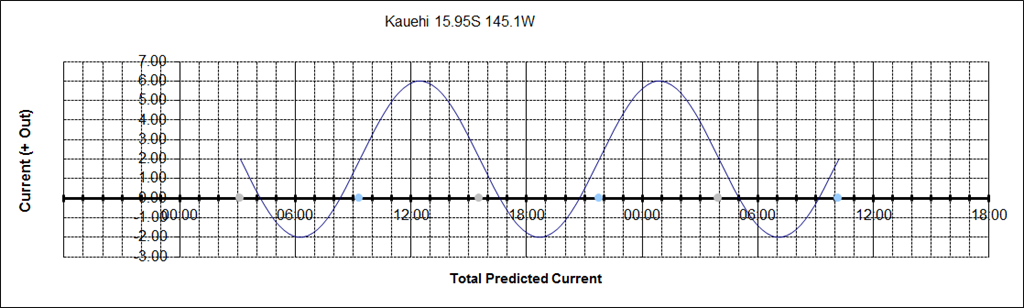
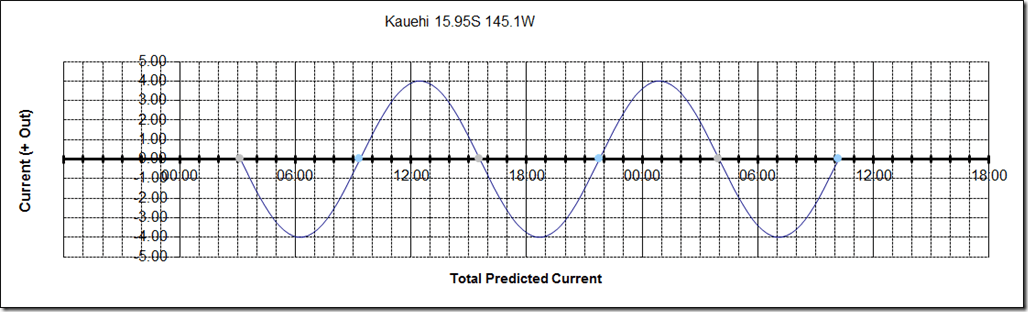
After delaying our departure at Makemo and getting a bit bumped around mid tide, I decided I would be a bit more careful entering Kauehi, where the normal tide is said to run to 4kts and to enter at the end of the incoming tide. The Tidal Guestimator, based on a simple time variation from the Rangiroa measuring station, gave me an initial high tide slack time of 0920hrs for 7 Sep 16.
image

I corrected it by adding in the Wind/Wave Factor, which we had guestimated to be 2kts and plugged the numbers into the spreadsheet. We had sailed here on the first day after a long period of reinforced Trades, blowing at 20-25kts from the SE. I decided to go back three days. That gave me two days of 20+ and one of 15+ and then I took 0.5kt off for the wide pass. Out spat the graph below. You can see two slacks in the morning, quite close together. The slack I needed with enough light to see to be safe is at 0815hrs.

image

Being prudent I had also looked at Charlie’s Charts for pass information, which then gave another direction for working out slack timings. 

“The current is slack 1.5hrs after low water in Tahanea, the closest tidal reference point”

Using the SHOM.fr web site (the official French Maritime web site – an excellent resource as long as you have internet), this offset gave me an initial time of slack for Kauehi of around 1045hrs.  A difference of 1hr 25mins from the Guestimator.  A huge variation! And using a standard sinusoidal graph, then I should expect the same current going in as out? Some mistake, surely?

Unsure what time to plan to and of my estimate of the wind/wave factor, we decided to arrive early. By 0745hrs, we were sitting off the entrance to the atoll, expecting to see the water overfalls the pass is known for during an incoming tide and to have to wait a while before it became calm enough for an entrance. Lou and I both checked with the binos. Nothing. No standing waves on the outside either. Recheck – still nothing.

At 0800hrs, we decided to take a turn in and ran into the pass expecting the tide to make itself known. Absolutely zip.

We pushed through quickly with less than a knot of tide against us and flat water. So, according to what we experienced, the tide was outgoing but near slack, which we must have missed by less than 30mins. Our estimate of the wind/wave factor had been about right, (maybe a 0.5kt light) and we got the conditions we needed to get in safely. Just look at how little time the incoming tide was able to negate the outgoing flow. We probably should have gone straight  in to the pass rather than standing off and debating what we were seeing. 

Perhaps the Guestimator’s accuracy could be improved. Some thoughts:

1. The addition of properly researched Rangiroa offset times for each atoll,  to me a screaming omission.

2. The Tidal Slack Delay times, if it is said to be a constant (and for the islands with data against them, it is), should be a completed column too but this requires some hard data to be collected from cruisers or extracted from the SHOM web page.  It may (as suggested in the Guestimator instructions) be easier to leave this column blank and discount it. If left set to 00.00, it will mean you won’t miss the slack because of it as you will always guarantee yourself that you will be early. However, this addition, given in increments of 10 mins up to 1hr 30mins, suggest that this figure should be nailed down further.

3. Tighter instructions on the use and calculation of the crucial wind/wave factors, perhaps with advice on a cut off on the number of days you need to look back on. Three days seems to work for me but we have been here with reinforced Trades only rather than anything truly foul.

However, if we accept calculating the slack really is at least as much art as science, then the current formula, used properly, is probably already as good as you are likely to get.

In the meantime, Gram Schweikerk who took the time to make the Guestimator up, still has it updated annually with new tidal information and as the only free resource out there for this problem, he and his helpers must be thanked and praised for their efforts. I will continue to use it and now have a far greater understanding of how to get the best out of it. I will also be donating to his beer fund which thoughtfully comes as a link on the document.

We have come to the conclusion that you need to take all published information with a huge pinch of salt. If not wrong, it will certainly be inaccurate as it is most likely written for a set of generic weather conditions you are not in.

The Tidal Guestimator is of great use but you need to think hard about the data it asks for if you are going to use it properly and get any semblance of an accurate answer from it. It is not difficult but it does require you to engage the brain. For ourselves, we will continue to aim to be early outside the pass, preferably waiting for the end of an ingoing tide,  watching for the period where the sea calms and slack approaches. We will continue to base it on tidal data and our estimate at the wind/wave factor which I hope will only get more accurate as we gain more experience in the atolls. Sometimes we might even have to push the tide but we will understand the why and when it would be best to do so.

I could say that we will try to get better with our Scientific Wild Ass Guessing. I prefer to say we will practise art.

SUPPLEMENTAL – ON LUNAR PREDICTIONS OF TIDES

It is interesting to note that the US Sailing Directions, Ocean Passages and Landfalls, The Pacific Crossing Guide and South Pacific Anchorages all discuss using the times of moonrise and set as the basis to work out slack water. I have to admit I have not used this at all as there seems there is considerable confusion between publications on just how to work out your start points.

From the US Sailing Directions for Hao:

“To avoid a difficult passage through the reef, vessels should wait for the two periods of slack water associated with the flood current, which are short. Slacks usually occur about 4.5 hours and 2 hours before moon rise; and again 5 hours and 3 hours before moon set. When the tidal race slows or stops, the channel may be entered. Caution should be observed, as the information given above is for average conditions only. Current rates and the times or presence of slack waters may differ from those the vessel may experience.”

With considerable experience as a UK Army staff officer (don’t believe what they say about us – we even understand what Navy people write), I translated this to “ hold on to your pants ‘cause we don’t have a clue what you’ll find but it will be hairy!”

Ocean Passages and Landfalls states that for the Tuamotus:

Slack water will be 12 hours from moonrise or moon set.”

Then it states

Using the 12 hour moonrise/set system you may find that the time for slack water does not exactly coincide with the tide tables but it will be close”

Lastly The Pacific Crossing Guide states:

“…the tidal flow in the passes can be predicted from the time of the moons rising and setting. The full details are given in the BA Pacific Islands Pilot Vol III. Briefly, there is a slack water 5 hours after moonrise, followed by the inflow, and slack water again 4-4.5 hours before moonset when the flow reverses; 5 hours after moonset and 3 hours before moonrise, the pattern is repeated. However, tidal flow can be dependent on swell and wind, and it would be wise to back up calculation for any specific atoll with local knowledge”

Compare the three and there seems to be a significant difference in opinion. Ocean Passages and Landfalls I am discounting as it looks like it is using a overly simplistic model. The Pacific Crossing Guide and US Sailing Directions are close although the US Sailing Directions is detailed only for Hao rather than for all atolls and seems to me to already have a calculation incorporated to account for a Wave/Wind factor.

The Pacific Crossing Guide description appears to be the best and applicable to use throughout the atolls. Knowing that the RCC and OCC both have a strong tendency towards well researched competency, I’ll trust my initial tests against tide timing data to their timings. Bless the British Admiralty and the days Britannia Ruled the Waves! The Pilot referred to is a wonderful read on the history and discovery of the Pacific Islands and contains fascinating information on weather with 30 years of measurements for the stations it uses. Sadly, in terms of tidal information, it expands only slightly on the information contained in the RCC Guide. My copy is the 9th Ed from 1969. I’d be very interested to compare it to a newer digital age edition.

In the meantime, I will need to look at this technique a little closer before I use it and will make up a sheet to write down the simple calculations although it would be good to be able to talk about time in increments of less than 30mins. Of course, you need accurate moon data for your lat/long but I have this from the excellent app, Star Walk. The answer will still need to be adjusted for Wind and Wave, so just as it does using tide tables, I think art may come in to the completed solution too.

 The Vagories of Tuamotus TidesThe Vagories of Tides

Kauehi – The Isle of Buried Treasure

For those only interested in the “treasure”, then jump to the end. PS. You’ll need to read this anyway as there is a clue in the text. Ha!

For the rest of you……

“Ah, you’ll meet Yul Brynner. Give him our best wishes please”, said someone when I mentioned we were heading for Kauehi next on the morning Pan Pacific Magellan Net (8173Hz @ 0800Local). Utterly confused, I asked what on Earth they meant. It turned out that the head honcho and centre of the village hierarchy, the man that ran the shop and seemingly the driving force in the Kauehi community, bore a strong resemblance to the film star. Now we have met him, we concur. 

Having entered the lagoon with no issues, we headed straight for the village of Tearavero. According to the charts, the direct route across the lagoon is absolutely clear of bombies, a first for us in the atolls. Distrusting this information we kept a close lookout but saw nothing. The first coral we saw was a large reef about 0.5miles off the village itself.  I am not sure why but unlike every other motus, there are very few bombies within this atoll. Some strange dynamic, I’m sure.

KauehiKauehi

We anchored 400m off just in front of the red post marking the end of the reef running out on the N side of the village, in about 25’ of water. We picked up and repositioned once to ensure we wouldn’t foul on one of the numerous coral heads. There are three anchorages here. The one we were in and then two others going N across two spurs of reef, each progressively more protected from SE winds, but further away from the small pier at the village. There is a French yacht parked here who got here and choose to stop three years ago. Gary, the owner, now runs a diving operation with one of the locals, using a rib to take customers to the pass to dive.

After the great bunch of kids and the relative civilisation of Makemo, Kauehi is sleepy hollow. The church bells ring at 0500hrs and then half an hour later to get people moving and presumably get things done before the sun is up. By 0900hrs, the place is a shabby ghost town, seemingly inhabited by land crabs and little else. The village kids have been packed up and sent off to school on one of the other islands. All that are left are the v smalls. You get the impression of life a bit more on the edge here with money not coming easily. Strangely there are no fishing boats working.

There is a Post Office and it has a Vinispot hotspot which occasionally works although the term hot isn’t very appropriate. The internet is dreadfully slow and we had difficulty getting mail downloaded, even using HTML. I resorted to HF radio/Pactor to get my weather.

We eventually went across to the shop and did indeed met Yul, otherwise known as Tiaihau, who was delighted to hear the messages I had for him from a couple of boats. The shop is not great but has the very basics and a large proportion of the goods are red label. There is little choice. Veg is restricted to potatoes and onions. We were surprised to see baguettes in one of the freezers but didn’t enquire on the price. He does stock beer and after a couple of weeks of abstinence, Lou and I enjoyed a bottle each to celebrate our arrival. He also stocks one of the dodgier whiskys I have seen, made with love and care in Tahiti…….

 Kauehi

Anyone ever heard of it? I doubt it gets much of a following on the export market.

We stayed around the village for two days, just getting our bearings. On the basis that village festivities, planned for that weekend, had been put back a week, we decided to head to the southern anchorage that An and Ivan on Vagabound had expounded.

Kauehi

We had a pleasant two hour sail which went past one of the very few genuine islets to be found within an atoll. These days it is a pearl farm base and you need to be a little careful of the oyster strings that surround the it. Most of the floats are a few feet underwater so difficult to spot until you are nearly on top of them. Deeper keeled yachts might find it easier staying to its E as they move S. There are few strings between the islet and the atoll.

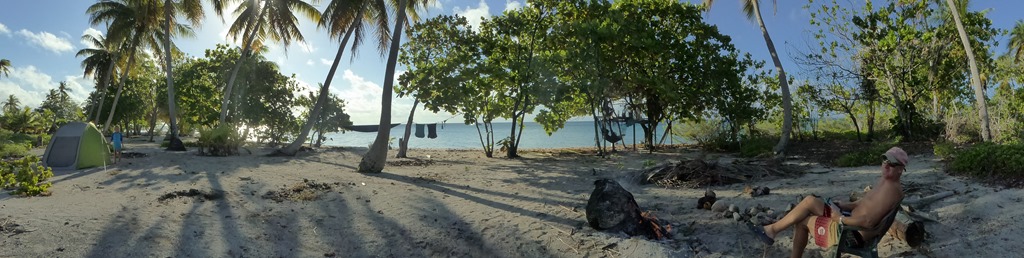
We reached the SE corner of the atoll and anchored in 12’ of water @ 15 57.550S 145 04.796W, just off a motus with a huge collection of fishing buoys decorating a tree by an old copra hut. Sadly these days Kauehi has very little copra industry. Termites have reached this atoll and coconuts don’t survive to dry out properly once they are on the ground which means most of the coconut groves on the uninhabited motus have been left to overgrow. Those coconuts that are collected around the village are stripped out still wet and the pulp is sent off to be made into a skin cream. Thankfully very few mosquitos have moved in to those groves left to themselves.

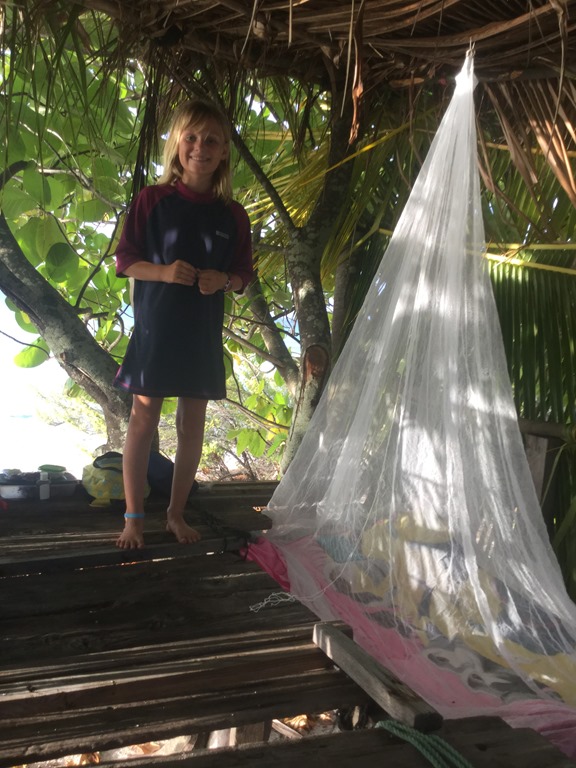
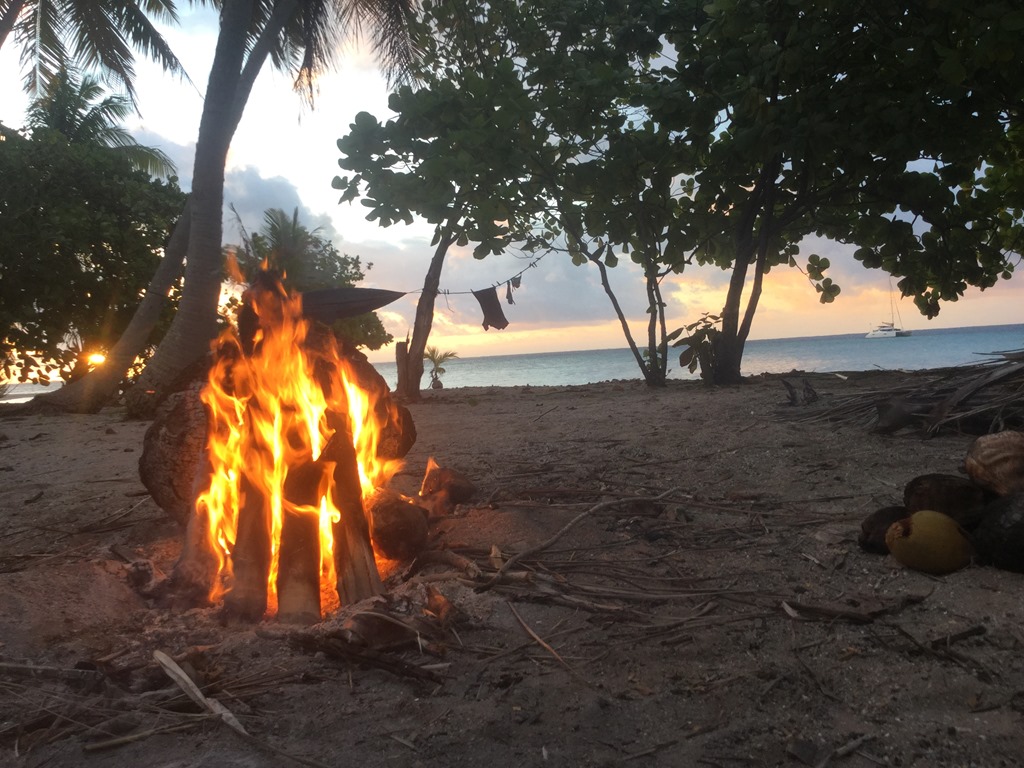
On our motus, someone had tried to keep the ground clear around the hut, probably for family outings down to its beautiful secluded beach. We left the coffee, sugar and milk power sitting on the dresser untouched but did borrow the plastic chairs and the head of a rake.  We found a sleeping platform 100m N of the hut. On the basis we intended to stay for a while and to help keep the place maintained we set up a fire to clear the ground spoil. There were piles of partially burnt logs and coconuts dotted around and we used the debris from those first before making inroads to the surrounding area too.  We had great fun doing the platform up, cutting new coconut fronds down to reroof it and build some side panels as well. Our weaving wasn’t up to much but it was enough to keep the wind out. The campsite also gained the sunshade tent and a hammock from ship’s stores.  The mosquito net that Kirsty left behind following her visit to Antigua also got an outing and made a very useful piece of equipment for the intrepid explorers.

KauehiKauehiKauehi

Kauehi

The girls decided that the sleeping platform was too good to waste so announced they wished to sleep ashore. Dad went too for the first night but equipped with a handheld, an approaching full moon giving good light and with the embers of a fire each night to go to bed with, they had soon packed me back off to the boat. The motus was renamed Margaret Motus in honour of my parent’s new Border Terrier puppy, named Peggy, and that became their onshore call sign.  Having just read an very interesting article posted by Mike on Sasquatch, on US society’s ever more draconian views on child care and parental neglect, I am quite sure Lou and I would be quickly arrested for our disgraceful lack of parental supervision in allowing the kids out of our sight and care on the motus.  My folks, who left my brother and I on the Shiram Mor in the Outer Hebrides as kids, would be equally damned in today’s self-righteous and barmy society. Personally I see it as excellent personal development for them. Although the girls used the radio to keep in touch, they enjoyed the stories about David and I signalling to Mars.

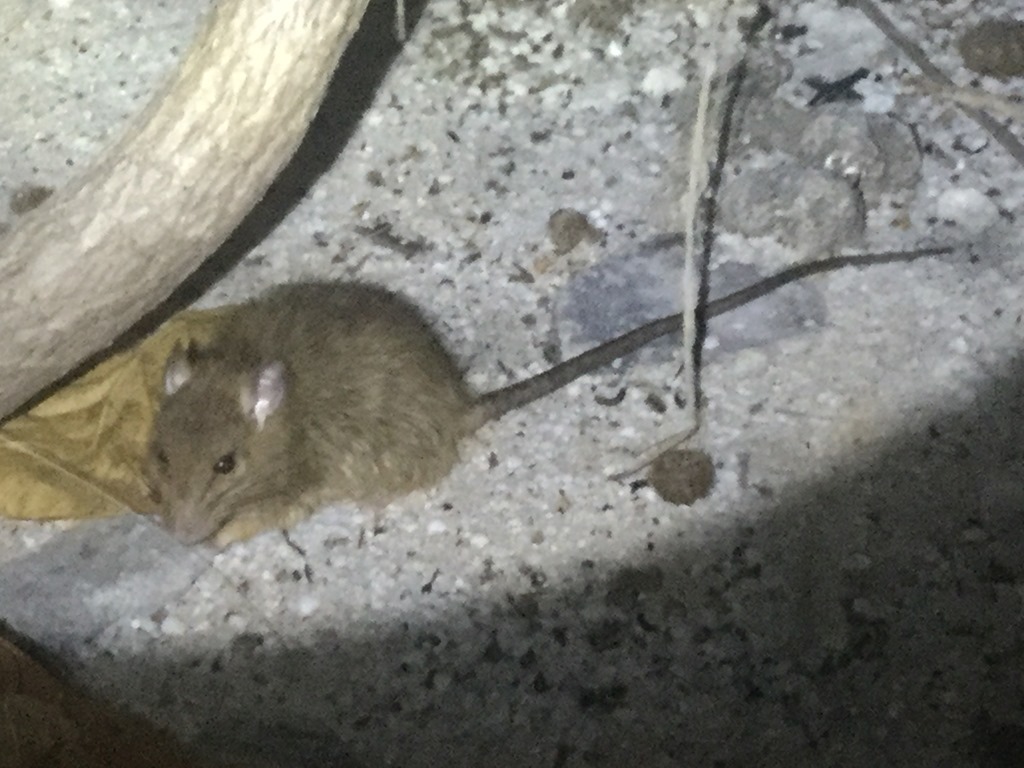
There were a few night time visitors to the camp. The normal thousands of hermit crabs were joined by a tree rat and then a couple of nights later, we saw two or three brown rats.

Kauehi

Tree rats are interesting creatures. As you travel around French Polynesia, you will see tree trunks fitted with wide metal bands to stop the tree rats from climbing them and eating their way in to the coconuts, their staple diet. Their movement is very different from normal rats, being closer to jerboa hopping with big back legs rather than a rat scurrying. The one we followed around eventually climbed a tree to get away from us but was not put out by us following it for some minutes. The rats shot off as soon as we got a light on them.

We lost two tupperware box lids to the Tree Rat one night. It chewed the rim of both box lids, obviously using its coconut opening technique rather than just burrowing through as a rat would. The girls were not bothered by either type of visitor and happily ate the cake the tree rat failed to reach. They believed us when we told them they were the biggest, scariest monsters inhabiting the motus! We used an empty all metal milk powder can to stop unwelcome interest in the midnight snacks after that.

Over the week we stayed, the fire grew in stature to the point we were burning the main base bulb and trunk sections, 18” in diameter, from a tree that had been cut down. We cleared huge amounts of dead fronds and hundreds of coconuts. Palm oil burns well. Other than one morning when we needed to relight it, it burnt for six days. The only thing we missed were marshmallows, a complete failure on our part, as Eleanor announced she had seen some at the shop but hadn’t told us because she thought they would have been too expensive. We have obviously being going on about the simple life and using up boat stocks too much. We did make up the bread sticks ZigZag showed us how to do back in the Marquesas and these went down well. As an aside, we just got a message to say that Noah has finally decided to start walking. Well done, the wee man! We used some glow sticks that we had bought long go in Puerto Rico so the girls had great fun playing with those. 

KauehiKauehi

We had some great snorkelling just off the campsite with good coral in no more than 10’ of very clear water. There were good varieties of Angel, Butterfly and Damsel fish and we were always joined by black tip sharks. We came across another shallow coral site a mile to the E of us, three motu up, which was worth swimming on too. H also found out what happens when she puts on my weight belt. Bouncing between bottom and surface to breath and trying to giggle at the same time is not necessarily a good idea!

Kauehi

The rest of the time was taken up with reading, feeding the fire, saving suicidal hermit crabs from the flames (a Hannah task), exploring the reef side of the motus and simply kicking back. We did look out for what was described as the site of an ancient village called Tuketuke which by local legend was in the SE corner of the atoll but we were unable to find it. I asked a couple of locals about it and I got the impression that no one is sure of exactly where it was. I rather think that the reef has taken it long ago.

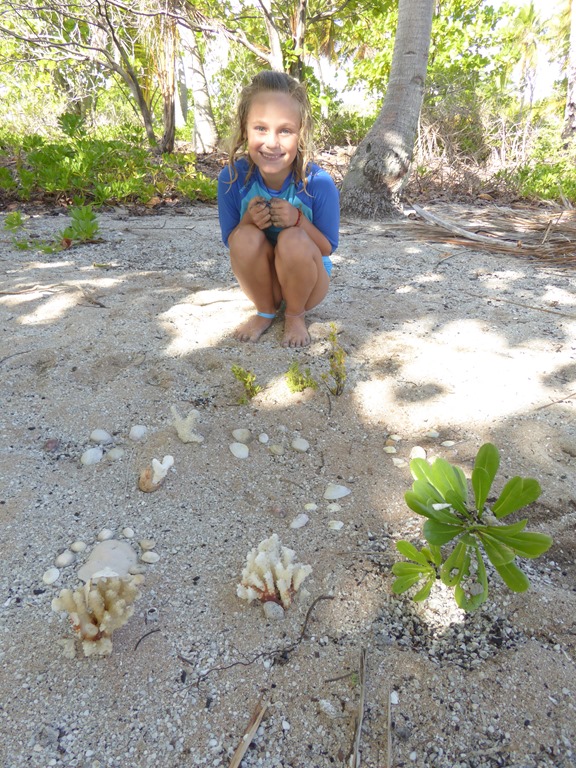
The girls had great fun making coral and shell gardens from their finds on their beachcombing expeditions.  Hannah had a very long, convoluted story about the ‘fortune tree’ in her garden and the hermit crabs were particularly fond of Eleanor’s garden.

P1050295P1050296

The night before we travelled back up to Tearavero, the weather blew up with gusts to 32kts which brought torrential rain. Both girls moved into the tent but survived the night no more than a little damp. Having packed up the camp and left it much clearer than we found it, we sailed back N, seeing only three bombies in the 8 miles run. We re-anchored off the village in time to join the delayed weekend festivities.

Night one involved chips (frites), dreadful background music (we felt the electronic Polynesian version of Gangnam Style was the highlight!), the disco run by Yul wearing a very grand coconut frond hat and a nearly 5 a side football match which ended up as a kick about rather than a match.  E and H had fun doing gymnastics, watched on by the local kids.

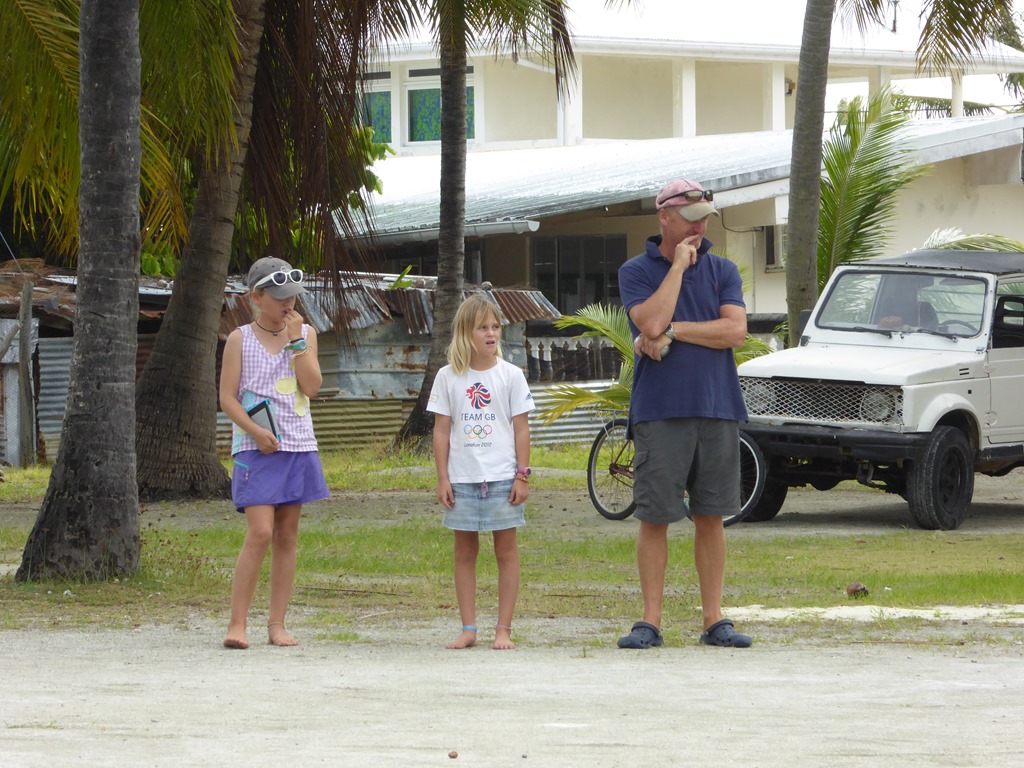
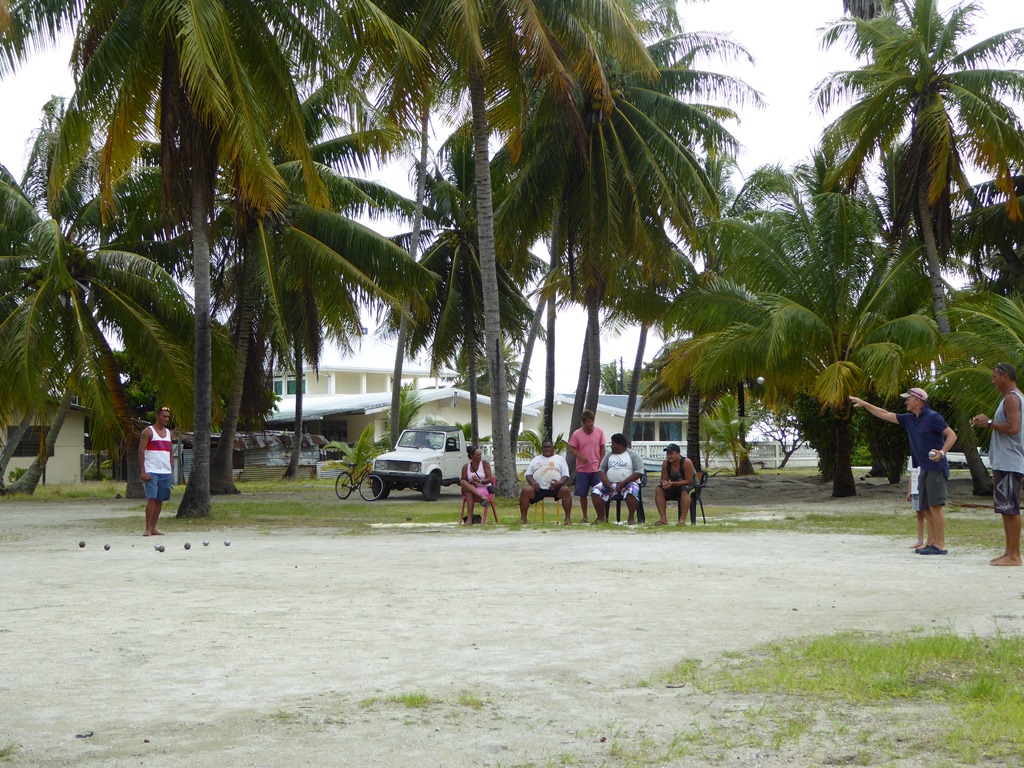
For day two and three, we had a petanque competition with first prize set as two chickens and two bags of rice. Lessor prizes included a bag of sugar.  My partner, Olivier, and I won our first match but came up short against the eventual runners up in the second round, losing 7-5 after a tight match. We didn’t disgrace ourselves and it was good fun. It was pretty competitive with 16 teams playing. The winners were an older couple who were scarily good.

KauehiKauehi

With a decent weather window approaching and little to attract us around the village, we decided to head for Fakarava, 35 miles away to the W. We greatly enjoyed the SE corner of Kauehi and would thoroughly recommend it. The motus we were on gave us the wonderful feeling of being truly alone on our own desert island and the shallow snorkelling was excellent. One of the highlights of the Tuamotus so far.

I am of mixed feelings on the village. The anchorage is pretty, the people are nice enough but there is little to see, (normally) less to do and I didn’t see anything there to attract us in. I think we might have been a little spoilt by Makemo. If there had been kids here, perhaps it would feel different. But I doubt it.

We left on 20 Sep as the sky burned at dawn, one of the best sunrises we have seen in the Pacific. We sailed, well reefed, at 8kts with a 20+kt ENE wind across to the pass and were fired out under sail being helped by a 2-3kt current. A very satisfying way to sign off on Kauehi. 

P1050377


Finally for those that come after us , the girls have left some “buried treasure” on the motus we camped at. Perhaps of interest to Oliver on So What, Hannah left some Pokémon cards. Please add to the stash and pass the word out to other boat kids. We might even go as far as getting the hide logged on to Geocache. I reckon it is exotically far enough away for it to be rarely visited.

Find the decorated tree with its orange and greens

Walk to the Sacrificial Table and look E along its edge to see the pathway

40 paces will take you to the crossing trees

Search for the black stone which has no right to be there

And look beneath!

Good luck

Makemo–pt 2

Ok, so we decided to stay. We were all ready to push off to Kaeuhi having finished the filial duties and been in comms with the old dears for their Golden Wedding Anniversary but then……. There was internet, it was great to be able to talk to families again,  Lou wanted to do some more booking of bits and pieces for New Zealand, the kids needed to do some serious school, Lou wanted to download more books for the kids to read and there was that internet thing……..

Typically, Skylark demanded some TLC as well. The large plate holding the taps on at the sinks disintegrated and with no hope of spares and the taps sitting loose, I fabricated from scratch a replacement. I was glad that the yard of aluminium plate I have carried for the last two years finally found a use as I cut a blank from it then shaped and cut it using my wonderful Dremel – a  bit of equipment that I would heartily suggest any long term sailor should carry. I am ever thankful that Robert from Almost There gifted his well stocked Dremel box to us in Puerto Rico when it was decided they were heading back to the USA. I’ve made jewellery, engraved Skylark’s name and number on items (including the dinghy), polished rudder posts, cut wood, metal, sharpened machete, shaped lots of bits and pieces and now some outright fabrication with it too. A marvellous bit of kit – as long as you have the right attachments! You need a small portable vice to use it properly –  $30 in Grenada.

Makemo

Just to take advantage of our our weak will and help us justify our decision, along came the rubbish weather with 20+kts every day, little blue sky and lots of rain. Although we collected a lot of water for showers in our jugs, the daily temperature averaged low 80Fs and the night time temperatures fell as low as the 72F. We missed the sun.

In the end we stayed along side for another week with another three French boats that came in, waiting for decent weather as we were. Sadly they were not exactly hospitable types. We had great difficulty engaging any of them in meaningful conversation. The two boys on one of the boats went to play with the French doctor’s kids at the other end of the village. The local kids were a bit put out being made into pariahs too. None of the grown ups wanted to visit us either (“perhaps later….”), not a single invitation to come on board so in the end, I was less than impressed with our fellow pier guests. The most unfriendly and insular group of boaters we have come across. Just rude. Our kids ended up playing with an ever increasing number of local kids most afternoons after they had finished school, Skylark being a convenient jumping in spot with the added attraction of a kayak, and having great fun. I occasionally apologised loudly, insincerely smiling  to the glaring bloke on the boat next door about the noise the kids were making. Before anyone says anything, this was some days after we had tried and failed to get along. By this point, I was at the “stuff it” phase. I certainly wasn’t going to stop the kids’ fun.

MakemoMakemo

Enough of the rant.

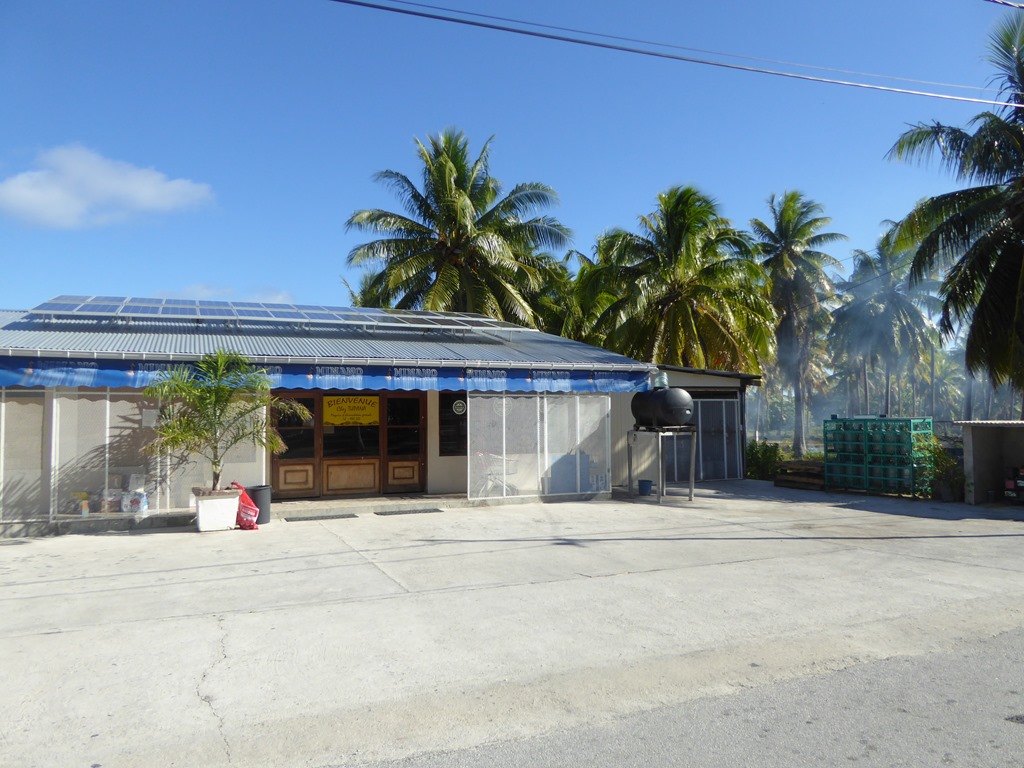
We explored more of the N side of the atoll and had a few long walks up towards the airport although we never managed to get to the airport itself, being five miles or so up the road. We also found another store a mile or so out of the main village, one that we hadn’t read anything about in any of the Guides or Compendium.  It is called “Bienvenue – Chez Tupana” and can be called on 980 333.  Two interesting facts about it for those that come after us

 Makemo

1. It sells fuel. Not cheap but diesel and petrol are available for those that really need it at $1.70 a l for petrol and $1.67 for diesel (Sep 16 prices). That works out to be about $6.70 a US Gal. I’m jealous of the 25c a US gallon price that Greg in Trinidad and Tobago on So What is paying at the moment. Fill up, mate! It doesn’t get any better than that!

2. Far more importantly, it sells Cadbury’s chocolate, plain, almond and fruit and nut, in big bars. Lou thought she had died and gone to heaven and I suspect at least one of her 500 days died a death because of it. The fact that they had stock allowed us to justify walking back up to the store a couple of times.

The atoll, being wonderfully flat and with perfect roads, was just the place for roller blades and scooters. Lou and I occasionally got to have fun with them but it was on sufferance and never for long! I did find out that it was impossible to carry baguettes in our made to measure waterproof bag whilst riding a scooter, much to the amusement of a couple of good natured laughing locals who, having seen me whizz past on the way there, watched me slowly walking back carrying the scooter in one hand and the baguettes in the other.

MakemoMakemo

Well outside the village on one of our walks, we were chased down by one of the wee girls who had taken us under her wing. She needed to make sure that we were back in time for a outdoor cinema that she excitedly told us would be held down by the pier that night. Cakes and ice creams would be for sale. She had decided early on that Lou’s French was good enough to follow her conversation so she talked at us in great long speeches. We couldn’t quite understand the references to a “discoteque”, but later worked it out that night after the kids came back having watched one of the Ice Age films in French to tell us about an second film for the adults, set in a disco. “They were wearing very short skirts and it had noisy music so we didn’t want to stay….” Oh, how that sentiment will change all too soon.

Makemo

On the way up to the store, there is a narrow cut that has been made into a small boats mooring field. You cross it by bridge and we watched as some of the local kids had a swimming lesson in its beautifully sheltered water.  Not a bad “baby pool”.  Every time we passed it, there were kids playing there, jumping off the bridge or just cooling off, chatting whilst sitting in the shallows.

Makemo

There finally seemed to be a couple of days gap in the weather and on the 6th Sep, we headed out having had one last stop at the excellent boulangerie. With about 100 miles to get to our next pass at Kaeuhi, we left having waited for bread, at 0930hrs on a falling tide, two hours after high slack. Perhaps not the best of choices. With wind over tide we had fairly significant standing waves as we exited and I was thankful we are a cat with an engine on both hulls giving us far more manoeuvrability than a monohull has. We got thumped with side waves and big eddies tried to spin us, requiring some fast work on the wheel and throttle variation. It wasn’t particularly bad (we had much worse coming out of Farmers Cay in the Bahamas) and was over in a couple of minutes as we got flushed out at over 10kts but for peace of mind, I think we will try closer to slack in the future.  The race continued about half a mile out from the pass but we turned out of it quickly and were soon in normal seas again. With the wind on our stern, 20kts blowing and with 1.5m waves, we set jib only, running WNW to clear the NE corner of the atoll.

It was an easy sail and we slowed down with a couple of turns in the jib during the night. Dawn saw us 10 miles short of the Kaeuhi pass at the SW corner of the island.

MakemoMakemo

Makemo

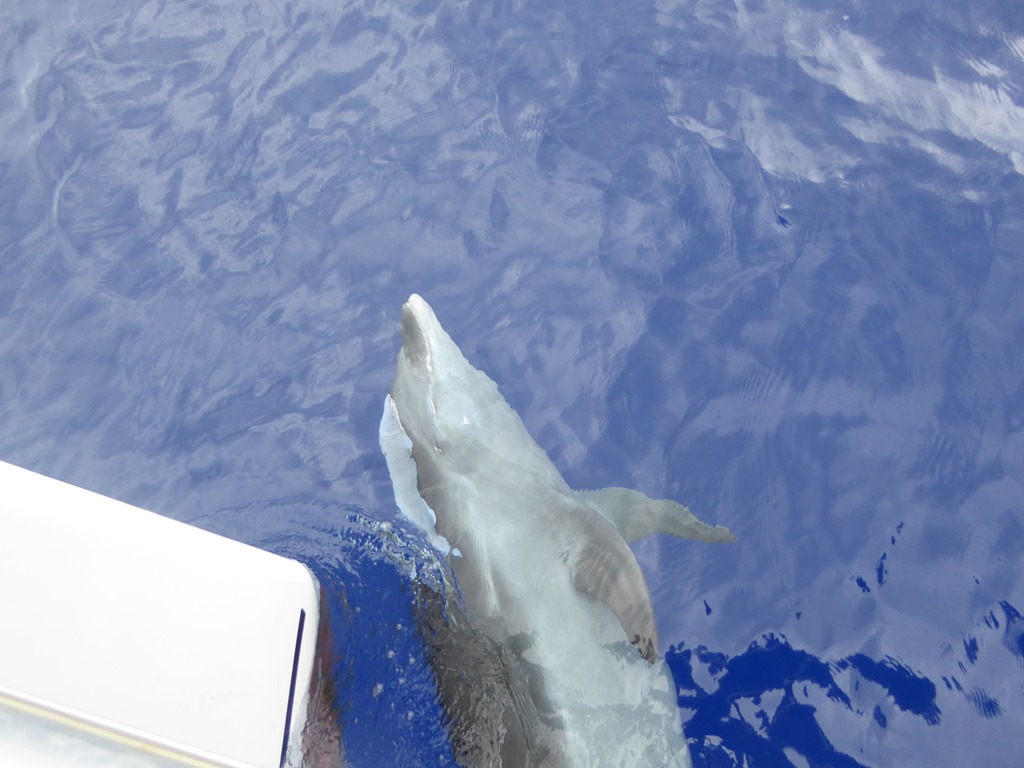
We left Raroia for the 80 mile overnight trip, hitting slack water perfectly at about 1130hrs. Just as we left the pass, we had an unusual visitor. A big dolphin, swimming upside down started to rub itself on the  port bow in an attempt to get rid of two Remora that were determined but obviously unwelcome visitors. It stayed with us for five minutes twisting, turning and bumping. The Remoras simply slipped position whenever it tried to hit them on the hull and as we were obviously no use as a scratching post, it moved off.

Makemo

After two weeks of flat atoll water, it felt strange to have a sea running again, even the 1m swell we had. As we turned SW on course a front meandered pass and our chance of a simple sail disappeared. 13kts of wind from the E and 4kts boat speed lasted all of 15 minutes. The wind dropped to 5 then 3 then 2kts. We threw the parasail up for an hour and managed a whole 0.8kts SOG before giving in and switching on an engine as the wind moved into the W very briefly then S. It took three hours to flick back E but once it did the main and jib went back up for the ungenerous 8kts we got. We had a slow night but in the end we timed in pretty well. I was surprised to see a lighthouse guiding us in towards the entrance, the first one we have seen in a long time. I think the last one we saw marked the southern point of Haiti and DR. We spotted it at a range of 20 miles as we came around the southern end of Taenga. We arrived at the SE pass of Makemo at slack water but waited an hour for some proper light and were carried in by a current of around 4kts. There were a few standing waves as we went past the large, white painted but unlit leading marks, but nothing worrisome.

We decided to use the excellent village pier which is free to use and initially tied up where the ferry would come in before moving to a med style mooring further in as the onshore wind increased. A Swedish catamaran, Alexander,  choose to anchor behind the pier and had a very nervous night as the SSE wind picked up to 30kts in gusts with just 30m of water behind them before they would be on the reef. They all looked tired when we met them ashore in the morning having had to do a double anchor watch. I slept beautifully.

ZigZag joined us the next morning. They had spent the extra day in Raroia trying to fix their watermaker. Sadly the patch Georg had tried couldn’t take the pressure and it had burst again. Their only solution is to buy a new pressure vessel which they think they should be able to get in NZ. We parked up together. With the wind howling and our wind generator trying to take off, there was no problem with power and our watermaker went on for some long runs to get them filled up as much as we could. To save us the heavy lifting,  we organised our own “ferry” to take water containers back and forward. It worked well!Makemo

We waited three days for the reinforced trades to depart, safely tied on to one of the best piers we have seen, sitting in crystal clear water with lots of fish around. The water is a little colder here and it may be that reason that the reef seems far healthier than those we have seen so far. It was a bit like swimming in a fish tank. Georg and I both had a quick go at ridding ourselves of some growth on the hulls. Skylark was pleasantly clear with just a few barnacles on the rudders. The hulls have a little slime on them – nothing to worry about – although the primer is showing through the antifouling in a lot of places.  I hoped it would last a little more than 6500Nm which is mileage we have done since we left Grenada nine months ago. Next time around, I’ll choose a hard paint or even better, an epoxy coppercoat……..

MakemoMakemo

The girls had a great time rollerblading around, swimming and playing with the local kids, both Polynesian and French, the sons and daughters of the atoll’s doctor and nurse, newly arrived on the island for a two year posting. There was time for baking with licking the bowl out, as always, being one of the more popular activities.

Makemo Makemo  Makemo

The main village of the island is Pouheva, on the N side of the pass. It has a population of less than 300 which jumps to over 400 during school term times as it hosts the main school for the surrounding islands and the kids board. By size and population, it is one of the biggest atolls and it is used as one of the central hubs within the islands, Hao, Gambier, Rangiroa and Fakarava being the others. It is one of the few islands in the Tuamotus with a doctor appointed to it who is there to cover for the school and the surrounding islands as well.

We have been surprised and pleased at the shopping here. There is a proper boulangerie (bread available from 0900hrs on a Mon and Fri, 0530hrs the rest of the week including 0530-0700 on Sun) and a large shop which is an Uig size store, about half the size of the big Marquesas ones but very proud of the three shopping trolleys stored by the door. Both are reasonably stocked and have the normal range of red label goods. We even found green peppers and a cauliflower in the store and the boat hasn’t been here for nearly two weeks! They are close together at the W end of the village and are about a 10 minute walk from the pier. The big store has a restaurant beside it with a menu of fish and steak. There are another two shops, one right by the pier which has a far smaller stock and offers an expensive laundry service, and “Chez Flo”, opposite the church which has even less but which does have a small kitchen dinner and does single recipe dinners for 1000XFP a head. Although it is popular with the locals, we didn’t try it.

Makemo

The village has a bit of money in it, copra being the mainstay industry but with a couple of fledgling pearl farms and I suspect, excellent French subsidies. All the garden walls are painted purple and white, houses are in good nick, there are solar powered streetlights throughout the village and people appear busy. They are also very friendly with everyone passing giving a “Bonjour” and a smile. Their friendly nature and willingness to interact made me think of the people at Spanish Wells in the Bahamas. There are a few cars on the very flat concrete roads but most people use bikes or tricycles to get around. Mia fitted in well with her little balance bike and attracted a few smiles. The speed limit is a whole 15kph – which of course gives everyone the chance to be sociable as they drive on by. The only down side is that all the dogs here seem to be big mastiff/pitbull crosses which are a little off putting.

Makemo

We stayed one extra day to see a church procession walked around the village. The town boasts the largest church we have seen in French Polynesia and in some of the guide books, it is talked about as a cathedral. It is certainly impressive and as always in the islands, with religion taken seriously here, the church is a focal point for the locals. Georg and Irene, both of whom describe themselves as lapsed Catholics, were interested to watch a ceremony that both had been part of as kids back in Germany. Even though the service was all in Polynesian, Georg was able to tell us the individual prayers at each of the six procession stops around the village.

MakemoMakemoMakemo

Having coped with the excitement of the procession and had a good explore of the village, we finished the day with sundowners and crisps by the lighthouse before moving back for dinner aboard ZigZag.

MakemoMakemo

After loading up with bread and milk, we headed down to the SE corner of the atoll. Once you get within a couple of miles of the end of the atoll, the number of small bombies increases to the point I felt we were slaloming around them. You need to keep the speed down, go in the late morning to get best light and have a very good look out. Most would not be dangerous to us with our 1.2m draft but the odd one would have stopped us cold.  We anchored in 20’ at 16 23.42S 143 23.64W and buoyed the anchor for the first time. We had to change the floats around to get the chain off the ground and I think we will need more buoyancy on the first float going forward. However, our first night had us turning as a front went over us and we woke unwrapped and pleased with ourselves. We made sure that we kept a good look out on the anchor, checking it daily to ensure a good hold and that we were doing no damage to any coral as we swung.

Makemo

ZigZag’s luck continued to be rotten. On the way down to our new anchorage, their auto pilot and anemometer both decided to roll over and die. Georg and I had a morning of taking the autopilot apart, checking connections and we had Eleanor up the mast cutting some fishing line inexplicably caught around the spinner. Although we got wind measurements back, the autopilot failed to spark. Raymarine 6001+ spare anyone? Their saving grace is that they have a windvane steering system so they will survive as long as there is wind. We managed a few days exploring the motu we were anchored off, playing in the shallow warm water behind the reef. The girls enjoyed more babysitting duties, looking after the smalls.

We were visited a couple of times by pie eyed locals down maintaining the coconut groves and drinking homemade coconut hooch, presenting us with fresh coconuts each time. We reciprocated with some yogurt cakes that we dropped off with them.  Copra is still the major source of income here and the undergrowth in the groves is cleared out to maximise the trees output. It also means very few bugs which means a beach day is a very pleasant affair.

MakemoMakemo

MakemoMakemo

With the wind scheduled to increase and their need to move on quicker than us, ZigZag left us on the day of the full moon to run up to Kaeuhi. They will spend a few days there before jumping down to Tahiti, hopefully to pick up new equipment to replace what is broken. They left with full water tanks after a final water run and a breakfast on ZigZag to say goodbye. A big thank you to Irene for forward planning a big can of Heinz Baked Beans for us to enjoy, some of the stock she put on nearly two years ago in Germany. Wonderful foresight!  There were a few tears from the girls. They have enjoyed having Mia to play with and the chance to haul out lots of Barbies, something they haven’t done for a while. Hannah gave Mia her Princess pink fishing rod and we hope that it will have been a success by the next time we see her.

We will be sorry to miss Noah’s first birthday at the end of the month but we enjoyed watching his first steps outside the Mayor’s office in the village. By the time we next see ZigZag, in NZ in November, he will be truly off and running. I’ll also be missing Noah shouting across to Skylark, wanting a conversation with us each morning. It was always a good excuse to go across and enjoy a cup of coffee. And yes, the water is that colour here before I get accused of photo-shopping!

Makemo

We had a few more days of strong wind and we were glad to be behind the reef as it looked distinctly unpleasant outside. The underlying swell in this part of the Pacific seems to be about 1.5-1.8m in height. Reinforced trades when a front comes through (20-25kts rather the normal 12-18kts) will quickly build that and this was about 3m. The most we have seen inside an atoll was a short 1m sea on a long fetch from the W which lasted an hour. Most of the time it is less than 15cm. What we have noticed is with the constant trade wind having a southerly component, whistling up from the Southern Ocean, the air temperature feels far colder than in the Marquesas. Our jug showers are done out of the wind, we have moved inside for our evening meal and bedtime includes PJs and blankets again. Of course, the temperature doesn’t drop below about 78F but it is all relative. Out of the breeze the sun is as warm as ever, somewhere in the low to mid 90Fs.

Makemo - credit to ZigZag

The snorkelling at the SE corner of the atoll has been excellent – some of the best we have had. We have stuck to the warm shallows and have finally managed to find areas that aren’t completely covered with young Sea Cucumbers which makes the bottom look as if it is covered with small turds. We have spotted some gorgeous fish. The list of new ones we have seen is impressive and it feels like the Bahamas again. There we were amazed at the number of new fish we saw each time we went into the water. It is even better here. Just today’s list included Exquisite Wrasse, an Achilles Tang,  Blue Damsel, Neon Damsel,  Pale Tail Chromis and a couple that we are still working at identifying. The number of Giant Clams and amount of hard coral types around has been impressive too.

MakemoMakemoMakemo

We have also been joined by some juvenile sharks in the shallows and adults around the bombies in the deeper water around the boat. Sleek and efficient, Hannah doesn’t like them much as they wander in for a look before gracefully disappearing back out of sight. We still haven’t seen anything other than Black Tips. Lou’s and the girl’s legs are in the background. The sharks don’t come any closer than about 3m.

Makemo

After my birthday on the 23rd (Shona will be pleased to know that although a tube of Smarties didn’t materialise, mush and a BIG can of beans did!) and a last long walk along the edge of the reef, we moved back up to Pouheva to allow us to get some internet and contact with home. Although we are on the other side of the world, we were able to dial in to talk to my parents before their Golden Wedding anniversary party. Although we were sad not to be there to celebrate the momentous day, it was great to catch up with them and Emily. The invitation to family, hopefully passed on by Dad, stands for those that want to visit the exotic Pacific and see places the tourists will never find. Remember we will only be here for a little time next year before we head home. Send us a mail and we will tell you where we will be.

There has been a certain amount of grooming going on. My hair poses no problems these days; No2 all over, minimal effort and quickly done. Lou’s on the other hand, has been suffering as there are no other women to trust with the scissors. Her proper last hair do was by Jennie from So What, so long ago in Saint Martin. In the end, Hannah got to attack the back and take a bit off and then I got to do some styling with the clippers. Lou seems pleased with both our attempts but then she can’t see the back since the girls broke the one hand mirror we had on board!

Makemo

We stayed at Pouheva for another few days as we realised that if we wanted to be organised for New Zealand, we had to start planning ahead. Both girls need new passports and so internet applications were made out. We still need to send in new photographs and finding somewhere to take correct ones may be difficult.  My new driving licence has been ordered. I don’t think Lou has any wish to drive all the time in NZ and fixed that without me even asking for it. We are also looking at doing some volunteer work, staying with a family outside Auckland and working on a farm. Something different!

We found that in our absence, hiding down in the SE corner of the atoll, civilisation in the shape of a brand new ATM had arrived and been installed by the Post Office. This is a very big deal as it makes it one of few atolls (we think three or maybe four, spread over the whole of the Tuamotus) to have one. It will be a point in their favour in attracting more of next year’s boats travelling through looking to replenish funds.

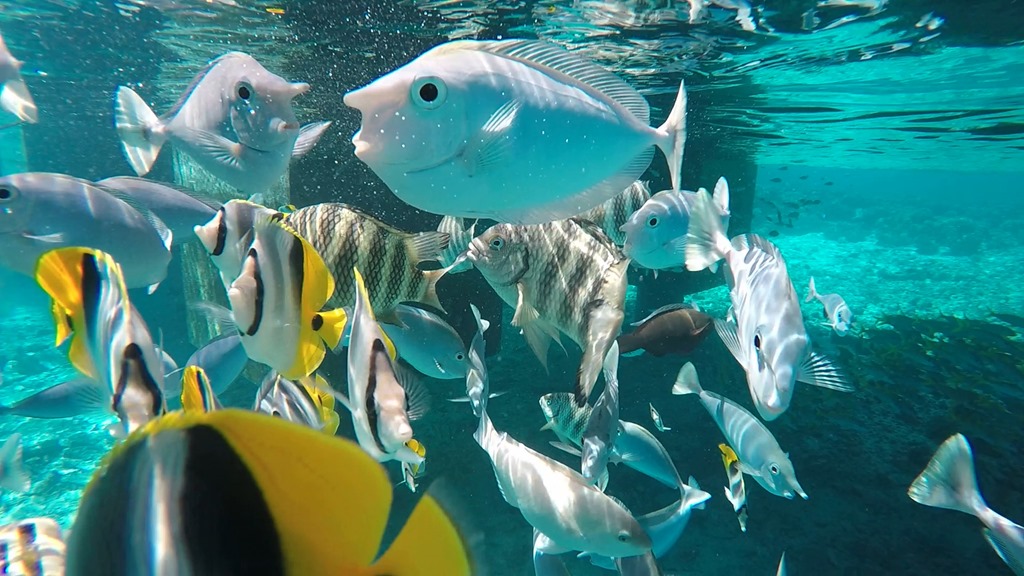
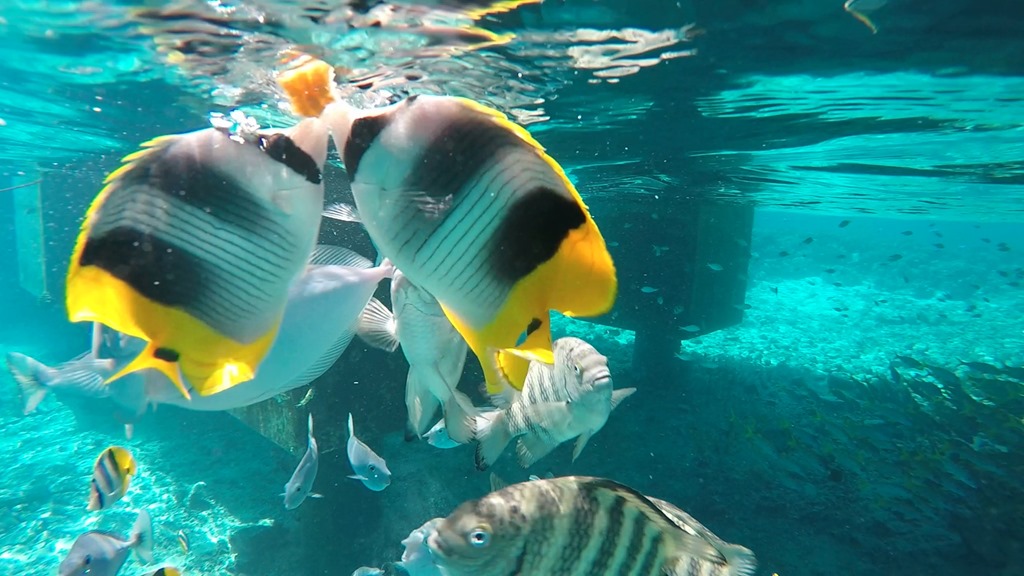
As we have readied ourselves to move on, we have been having fun with all the fish surrounding us back on dock. Drop a few crumbs of bread and you end up with schools of fish appearing. Every time I see one of these unicorn fish, I have flash backs but can’t make up my mind if they are from Monty Python’s The Meaning of Life or one of the weirder Beatles videos. Someone put me right please!

Makemo  Makemo

We have loved Makemo and the mix that this atoll offers. The people of the village are happy and welcoming, our ability to reprovision with more than just the very basics was a pleasant surprise and the solitude offered in the SE corner of the atoll is glorious. And the water, crystal.

Simply beautiful.

Raroia

I read an article on Lou’s Ipad by Roy Starkey, a long term cruiser now living at Hog Island, Grenada who for the last 36 years has cruised the world three times round in search of Utopia (see www. yachtingmonthly.com, Feb 16). He complains about the changes he has seen over this time and even takes a swipe at the Hitchcock’s way of life, when he met them back in the 70’s. He argues that the Tuamotus is the one place left where Utopia exists mainly because…… “ there is nothing there. Nothing to develop. Even the locals have gone away, chasing the western dream. It is the one place left where you can truly find peace and quiet”.

Sounds wonderful. I wonder then why he has chosen to settle in Hog Island, in my opinion a God awful place, over crowded and smellier than most anchorages in the Caribbean.

Hey ho. Our arrival at our first atoll in the Tuamotus gives us the opportunity to make our own assessment. Raroia is about halfway down the Tuamotus group and is one of the most easterly atolls in the northern group. It has a population of less than 40, mainly in one village on the W side of the atoll with six living at the pearl farm on the E side. It is about 15 miles long and 5 miles wide. One thing we immediately noticed was how cool the nights were. The 400miles S we have come have been enough to drop the night time temperatures to about 80F and we needed to break out the blanket for the first couple of nights until we were used to it again. Daytime temperatures are in the low to mid 90s but fresh due to the constant breeze –  really very pleasant.

The first couple of days were windy and cloudy as the front that gave us all the wind in the last day of passage down here went through. The shoreline in front of us had hundreds of downed coconuts floating in the flat sheltered water, all blown down by the wind that went through. I don’t think it went above 35kts but it is the first strong wind the island had had for a while.

We used the time to fix a few small boat issues, catch our breathe and restart school. We visited some of the closer motus and found some floats used by the pearl farming industry, washed up on the outside of the reef. We decided that we would donate them to the pearl farm in the hope they might be nice back. It didn’t work. I now wish I had kept more than one of them. More on this later.

Our anchorage at 16 06.16S  142 22.70W is glorious and one of the most picturesque we have been in. Sadly the motu in front of us, with all the shelter provided by the coconut trees, has spiders (my ladies are wusses – imagine the squeals), mosquitoes and no-see-ums so it isn’t quite paradise but there is lots of shallow water which, when the weather permits, is wonderfully clear. The snorkelling is ok and we have been conducting swimming lessons – finally getting Hannah to do proper breaststroke, rather than her own particular version of it. For snorkelling, we have been exploring the bombies S of us. The list of new fish has been exciting Eleanor and the “Reef Fish Identification – Tropical Pacific” book by New World Publications has been getting a hammering.  My favourite one so far is the wonderfully named Humbug Dascyllus – think of a clownfish but in black and white – although the 18” baby Peppered Moray Eel that panicked and tried to hide under my foot takes a close second!  It is also been nice to have a resident team of Sharksuckers (similar to Remora but bigger) beneath the boat again, the first we have seen since the Bahamas.

P1040756

The anchorage is by the largest motu on the E side of the atoll. Most other motus have far fewer trees or bushes and more wind, eliminating the bugs. They are on average 400-500m from outer reef to bay with the motus never more than 250m of that depth. The rest is made up of old coral reef, brutally sharp, with narrow gullies between each motu with water running into the bay at a good rate from over the reef. The fastest current we have seen was about 8kts. The sand on all of them is a vivid orange. Who needs “posh” pink sand? This stuff is amazing. Ginger sand!!

P1040715

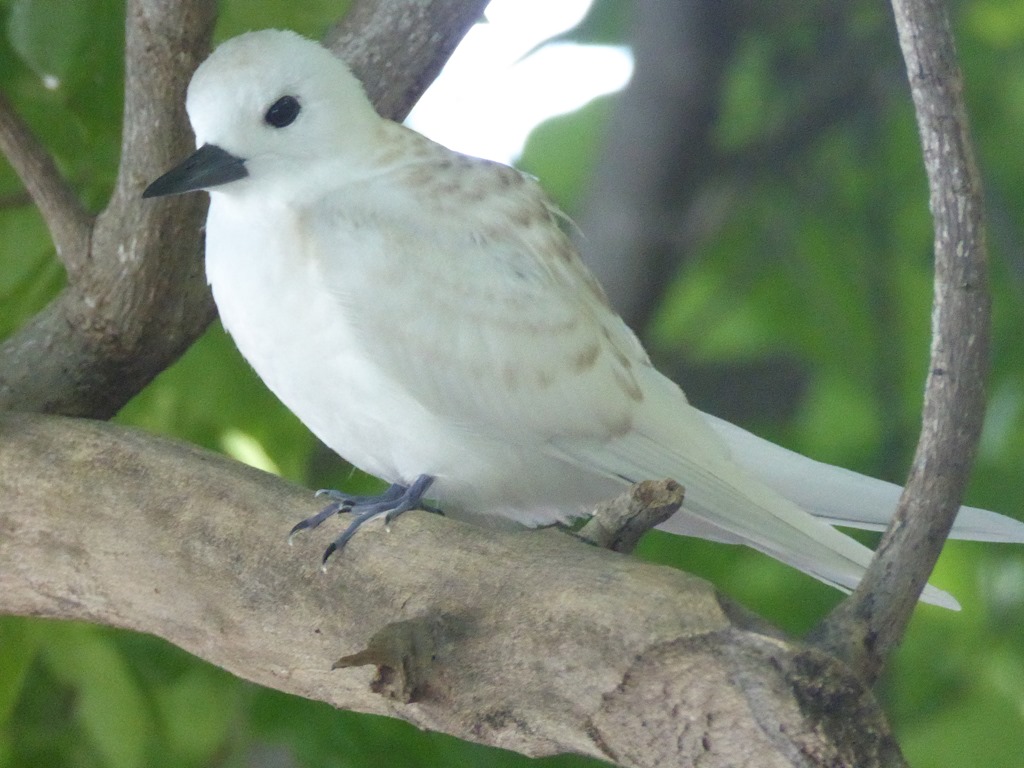
A couple of motus down, we came across a small nesting colony of terns. There were two types, as alike as chalk and cheese but happy to be around each other. They obviously hadn’t seen man often as they weren’t bothered by us walking past quite close.  Whilst we have a great collection of reference books on board, one we are sadly lacking is a bird identification book. We may have to try and rectify this when we hit civilisation again.  However, two birds that I was amazed to recognise by sight and their calls were some form of Curlew and Peewits, both of which are here in some numbers. I will be interested in looking at the migration patterns for both birds to see how the W coast of Scotland and French Polynesia fit in to their schedule!

Nesting terns - A chick in the nest and an adult  P1040776

One aspect of coral sand I “knew” but hadn’t really appreciated, is just how viciously sharp it is. There are few areas of truly soft sand. Most beaches have small lumps of broken coral mixed in. After our first foray ashore, we quickly decided that we need to wear shoes all the time.  Crocs, as I found, are just too soft and neither protected my feet adequately nor will they last long against the extraordinary roughness of old coral. A word to the wise. The locals here mainly use a clear plastic sandal, the same shoe we saw used in the Marquesas and sold in every store for about $20 a pair. I’m not sure how long they actually last but the French sailors who have been here a while almost uniformly use them. I think we might invest in a pair of these each, just to protect the decent shoes we have. My old beach shoes lasted just one visit ashore before falling apart, the sole ripped from standing on something terminally sharp.

 A typical cut between motus. Note the sharp coral - evil stuffAttempted arty shot

We also looked at how to ensure we protected the dinghy too. It isn’t as much as new procedures as absolutely enforcing the rules we used before. I have no wish for punctures so getting in the dinghy involves a sanitising of all coral sand from body and shoes before people are allowed in. The dinghy is always anchored off and not allowed to touch bottom. The engine is always lifted to protect the prop from coral lumps once we get to wading range of shore. We swim or wade ashore.  I’m also very glad that I put 6’ of chain onto my dinghy anchor. I don’t think rope alone would last long. I wash out the dinghy daily to catch any last piece of sand we may have missed.

Our visit to the Pearl Farm was interesting. We saw the oysters being prepared with plastic ball inserts and an irritant to stimulate the growth and the girls got to wear a lot of moneys worth of pearls. They wanted $800 for the necklace which I think would be pretty good value but not quite what we were looking for.  The technical work is being carried out by a couple of Chinese, the labour is locals and the management is from New Caledonia. Although a bit difficult to see and much to the amazement and amusement of the girls, the lady behind Hannah has her eyebrows tattooed on!

The pearls here come in two sizes. The ones around Hannah’s wrist are one year pearls and each are the size of a large pea. The necklace is made of two year pearls. Two year pearls are simply one year pearls reinserted to a second oyster and allowed another year to grow. We came away with some fresh oyster shells. I’ve already had a go with the Dremel and my first effort in jewellery actually came out looking pretty good, well enough that the girls argued over it. I need a bit more practise before I make my fortune in it.

P1040703P1040696

The differences in the sea and inland side of the motus are marked. The bay side is what you would expect of an island paradise. Beautiful sand, clear, flat water and idyllic tropical islands in abundance. The seaward side looks like a moonscape. Rough smashed up old coral in a flat plain extending hundreds of metres towards the sea and extending right round the atoll. We have been surprised and pleased how little litter and rubbish we have found washed up. The odd fishing float (returned to the pearl farm), one lot of fishing line (removed after some effort) and the occasional plastic bottle but that is about it. We also found a whale’s skull. What type, other than a baleen, we don’t know but it looked like a youngster’s by the size of it.

P1040711P1040819

A whale's skull

The weather since we arrived has been variable to say the least. A near gale to arrive to, lots of rain, lots more wind and generally overcast. It is obvious that the Easterly trades aren’t always the “established” weather pattern as they are a little further N in the Marquesas. We have had all points of wind including, for a surprising six hours, from the W before clocking v quickly back through S to ESE. As our forecast grib has a six hour snapshot, we missed the fact it was coming. The saving grace was the wind was weak and never went above 12kts. At 0200hrs with no moon and no ambient light, we ended up in 4’ of water and had me sweating a bit about two small lumps of coral just on the edge of our swing room. Our draft is 3’ 2”. Note – front here mean front and you will see the wind clock right around the compass as one goes through. That is very different to everywhere else in the Pacific we have been to so far where a wave may through the wind out by 30-45degrees and strengthen but little else until the trades reestablish themselves.  I got away with it this time but have learnt my lesson. Make sure you get a 3hr grib forecast if there is a front coming through and expect a clocking wind. I think I’ll also need to be more conservative on my anchoring sites or be prepared to move well before a change in the weather arrives. It really calls for the Georgetown Shuffle (Bahama sailors will know what I mean) but here movement is limited because of the dangers of bombies.  The other item of note is that whilst you have the ability to find good sand patches on the E side of atolls, sand blown over the reef and deposited by the sea, on the W side of atolls you will invariably be anchoring on coral.

Whilst we did not need to do it this time around, the buoying of your anchor is good habit to get into here. By buoying I mean, putting buoys along your anchor chain to lift the chain from the bottom to allow it to swing 10’ above the bottom, generally above the height of the coral lumps to save you getting wrapped. The technique is discussed in the Tuamotus Compendium which I strongly recommend you take a look at. I have borrowed a picture as they have done from Sail Magazine.

image

Our new French friends, Luc and Jeanette on FANO, having lived here in FP for six years, do it as a matter of course,  always have two floats out and thoroughly recommended the practise. They only very rarely wrap and even then it is normally the first 20-30’ of chain rather than anything more serious. In a typical 35-45’ anchorage, the first buoy is attached around 10-15m from the anchor which allows the chain to lie at the correct angle. The second float is half way between that 1st float and the boat. I made up one float, hand sewing a carbineer and webbing strap on to the base attachment of the float. Having given away all the floats we found when we first arrived, we need to do some more beach coaming to make ourselves a second.   

IMG_1395[1]

We attempted to jump up to the Kon Tiki anchorage early in our stay but quickly decided to move back S and wait until the wind moved back into the E. There was just too much swell developed in wind with a Northerly component. On our second attempt, we anchored at 16 03.84S 142 21.70W on sand in 45’ of water with 20kts from the E and no swell.  It was nice to hear the wind generator working again after the shelter of our first anchorage. Absolutely no requirement for the generator at this site.

On anchor. Dawn over the Kon Tiki motu

We had a three days exploring the Kon Tiki site and the reef either side of where the raft came ashore after its long trip in 1947. It hit the atoll as the strong westerly current here and trade winds were too much for a raft that had no pointing ability. They simply couldn’t steer the raft well enough to go around the atoll. There is no marker to show where the raft hit on the reef itself – it wouldn’t last long  – but there is a small marker in the middle of the motu 200m E of the anchorage erected in 2007, the 60th anniversary of the voyage. 

P1040785   P1040795

It is amazing to think that nearly 70 years ago a small group led by Thor Heyendahl decided to sail across the Pacific to prove his idea that Polynesia could have been populated from S America. Although most of the ideas that he expounded have been proven wrong since, his endeavour and sheer guts to do as he did with his team still takes the breathe away. 4000+miles on a raft able only to sail downwind and at a slow walking pace. It is a staggering achievement. We cruisers worry about being able to do it now, helped by all our technology. Imagine what it would be like setting out on an unproven reed raft with the limit of technology available being a sextant with the breadth of the Pacific to go. I’m reminded of the James Hunt interview (a world champion F1 racing driver in the 70s) by Stirling Moss when he was asked how he did what he did so well. His answer – “Big balls” – stands as one of the most accurate and succinct answers I have ever heard. I think you could apply the answer equally well to the Kon Tiki crew. Oh and add in a bit of crazy as well……

The motu is home to number of female Frigate birds and a flock of terns who kept us under close supervision as we visited the memorial.

 P1040798Skylark and tender parked off Kon Tiki Motu.

The channels in between  motus are vibrant with life. In the channels with less current, you will see hundreds of Sea Cucumber (Eleanor’s description – things that look like lumps of poo) and large schools of juvenile fish feeding in the protected shallows. They are a nursery for a variety of Moray eels too. We have seen baby Giant and Peppered Moray eels, none more than 2’ long, swimming quickly from rock to rock and sometimes getting confused what my large blue crocs were. At the entrances to the channels, just as the water gets deeper, you will also see juvenile (3-4’) black tips sharks, playing in the warm shallows. Some came to investigate us as we were crossing between two sand bars, quickly scooting off once they realised we were uninteresting.

GOPR3157-0002 (3)

I have tried again to take photos of the superb night skies here. Sunset here is about 1730hrs and it is pitch black by 1800hrs. With a quickly setting waxing moon and clear skies, I thought I wouldn’t get a better chance to take some good photos of the Milky Way that blazes above us every night. Although I have tried on several nights, I have come way disappointed. It seems our camera just isn’t up to it, even experimenting with 15 and 30 second exposure times. We need a camera with a bigger aperture, something of a SLR size, I think.

We have Venus, Jupiter, Mars and Saturn all visible at the moment. We watched whilst the Moon slowly occluded Jupiter the other night and there are shooting stars and satellites aplenty. And the Southern Cross sitting alone in its dark patch at the S end of the Milky Way. Just beautiful.  Memories for me but nothing to show you. Sorry. 

Just before we left we unexpectedly met up with our friends Irene, Georg, Mia and Noah from ZigZag, last seen in the Marquesas, which led us to stay an extra few days. After our initial catch up over coffee and mayonnaise cake (a new and very good recipe Lou has found – see that new section of the blog site),  they moved up to our more sheltered anchorage. They had a major problem in that their watermaker high pressure container had cracked and they were down to their last 20l of water as the entered the atoll. We gave them some of the left over epoxy we had from fixing the rudder at Hiva Oa and it took a day to get a few layers built up. The watermaker hasn’t been on yet as Georg wants to give it a decent time to cure before he starts putting pressure in it.  In the meantime, we ran our watermaker were able to give them some water in jugs to load them up. It allowed them stay and enjoy Raroia for a few days rather than just rushing through to Makemo where they should be able to fill up at the pier, one of the few places you can in the Tuamotus.

We had a last day on the beach letting the kids eat sand and have fun. Georg and I tried to catch some coconut crabs by baiting an area with split coconuts but all we attracted were hundreds of hermit crabs. We also went for a night stroll equipped with big torches to wade at the edge of the reef to see if we could find any lobster. Another abject failure but we did see a Napoleon Snake Eel which buries itself in sand and only comes out at night which softened the blow to the egos. Our last night BBQ ended up with the traditional burgers and sausages.

Georg and Mia on the kayak with their propellor, HannahNoah still nearly walking!

As a first atoll and introduction to the Tuamotos, Raroia has been great. With very few yachts and almost no locals, the place is a quiet as a grave and as pretty as a picture. What is Utopia, I wonder? Everyone will have their own definition. If solitude, unspoilt natural beauty and fantastic anchorages are key ingredients, then I can see why Ray still thinks Utopia can be found here. For us? It is beautiful and we are loving it but we need to see some more atolls to establish our definition before we make judgement.

Onward to Makemo.

Skylark at rest at Raroia

From Fatu Hiva to Raroia

After the disappointing weather we had at Fatu Hiva the forecast was for a few days break then some heavy weather coming up from the S. If we didn’t move to the Tuamotus, we would be stuck at Fatu Hiva until the next break, which would be over 10 days away. As it is, the weather over the next few days should be perfect for a nice, easy reach all the way to Rarioa, 400miles away and our first atoll. With the wind forecast to drop considerably as we approach the atolls, we are aiming to arrive for before the high slack water at 1239hrs 29 Jul.

Two key documents I would recommend to anyone sailing towards the Tuamotus which I have been using as planning tools are:

The Tuamotus Compendium and the

Tuamotus Current Guestimator

Both are the product of many years of cruisers input and are extremely useful sources of information. The Compendium is probably better and has at least as good information as Charlies Charts and is easier to get around as well. The current guestimator is updated yearly so ensure you have the most up to date version available – if you don’t then it is useless. It is a god send when you are trying to work out when the current at the entrance passes to the atolls will be safest for transit. 

We packed up and had a lovely last morning with Dale and Tanja from Dragonsbane, an US boat who had just arrived. Professional sailors, now in semi retirement, they are circumnavigating. We had invited them across for coffee and they turned up with a blackberry sauce, a caramel dip, a sausage version of a fatata (wow) and the hard butter biscuits that the Marquesans love so much. We had a very pleasant breakfast talking about all the best anchorages for them to visit during their short stay in the Marquesas. We swapped some cruising guides for copies of new ukulele music. On the basis that breakfast was far too good, we missed our chance to get to the post office but Dale and Tanja have kindly taken it upon themselves to post the cards for us.

Music Practise

Day 1.  Posn @ 1200 – 2m S of The Bay of Virgins   Distance run –  69 miles 

Lifted anchor at 1130hrs in sunlight!! Typical! 20+kts in funnel that is The Bay of Virgins then almost immediately no wind until we cleared the lee of the island then 15-20kts ENE with a 2.5m swell. 1 reef and full foresail. Occ squalls to 25kts. Dry and clear. Easy, comfortable and fast sailing.

Farewell to The Bay of VirginsHeading out. Faku Hiva from the SW

Day 2    12 14.950S  139 37.668W  113miles

Wind has moderated overnight to 12-15kts ENE. Swell 2m with a long interval. Course 200T. Hardly a cloud in the sky. Going along comfortably at 5-6kts. It’s boring when it is as good as this! Spent the morning marking up the Marquesas Chart with all the anchorages we used and our route around the islands. The girls are reading. Hannah has just finished “ Confessions of a Murder Suspect”. Not sure how appropriate it was but she claims to have enjoyed it! When not practising her hand steering (saved the batteries an hour of autohelm this morning), Eleanor is getting stuck into the Anne of Green Gables series.

Eleanor hand steering

The rest of the day has been uneventful. The wind has continued to drop and now sits between 8-11kts from the E. Boat speed is 4kts.

Day 3   14 02.170S  140 47.625W  107miles

An interesting night. When you reef, you let the main sheet out to take the pressure off the main. Unfortunately, someone had been practising their figure of 8 knots and hadn’t put it back in when they finished. Result? Sheet pulled through all along the boom to the mast and back out the pulley block at the end of the boom. Trying to fix that at 0230hrs in the pitch dark was trying! Eleanor woke to my swearing and helped, first by steering whilst I tried to rerig things and then as a boom weight to bring the boom down to a manageable height. She did very well. We practiced some steering by the stars after we were reorganised. She now knows the term “precession”!

By the morning the seas were back up to 2m and wind had gone E to 16kts. By the evening, 10kts from the ENE and slowly decreasing. Slow going.

We had a quiet day with both girls hand steering. We did have a strange companion for a while. It had the shape of a tuna but the tail and half the back was a purple colour, markedly different from the blue of the head. It travelled up by the bow for 20 mins and we watched it chase down small flying fish.

With 140miles to go and no chance of making the cut tomorrow, we are going along at about the right pace. At this rate we will still have 6-12hrs to wait before we can think about trying the cut at Raroia.

Day 4    15 10.688S  141 2.740W  98miles 

As the light died last night, so the wind eased to the point just after midnight there was less than 5kts. We bounced along doing a couple of knots, largely wave driven but by 0600, we had had enough of 2 miles per hour and started the stb engine. I fear this is the calm before the weather front coming up from the S  reaches us. The only point of interest through the night was the large shark (we think) holding station just under the boat. It set the depth alarm off regularly, which was off putting to say the least. We often see schools of fish showing up at a single depth then quickly disappearing. This thing held station with us and we could watch it change depth. We tried searching for it with the big torch but saw nothing. It disappeared as soon as we started up the engine.

We motor sailed with less than 8kts, the wind gradually getting more and more  of a southerly component, right through the day . At last light, the wind arrived. 25kts and from the SSE! We haven’t seen a wind from there for a long time. It gave us a bouncy but fast sail. Thankfully the sea was slight due to the lack of wind the previous days and we managed to get into the lee of Raroia before anything got violent. We reached the cut just after midnight.

Day 5 On anchor @ 16 06. 230S  142 22.711W  28miles 

With 8hrs to kill before slack water, we hove to. Catamarans aren’t great at this but we managed to hold our speed down to under 2knts and meandered back N up the island. At the top of the island where it started to get lumpy, we turned round, sailed back to the entrance and did the whole thing over again. At 0630 we moved towards the cut, dumped sails and got ready to try our entrance just before low water which was at 0806hrs. By 0745hrs, we were through, still against 2-2.5kts of current in the deeper water on the N side of the cut. But we had flat water and no standing waves. An easy entrance. 

Going in to an atoll, you should always try for decent visibility so you can see such dangers as reefs and bromies (huge lumps of coral that stick up 100’ from the bottom). Sadly, the weather had other ideas and I was back to using a facemask, looking into the driving rain and 25+kts of wind. We just had to take it very slow (less than a knot steerage way) and wait for the weather to clear which, after an hour it did.

I think that someone has taken a look at a google snapshot and overlaid the position of the obvious large bombies. Navionics seemed to be pretty accurate for the these although we spotted at least five smaller ones that definitely weren’t marked on the charts.  Be warned! Even with the awful weather, the girls were a great help and suitably equipped with waterproofs, they stood at the front acting as extra sets of eyes.

And the sex pest to your right is......The girls ready for bromie spotting

Having seen lots of jumping fish and birds (several types of terns and a few Frigate birds) feeding on them, we threw out the line and within 5mins we picked up this beauty. Not knowing what it was and unable to verify it with a local to be ciguatera free, we chucked it back. However, it bodes well for fishing here! The place is hoatching with life.

  Unidentified big fish caught after 5 mins fishing

Being a little exposed, we decided against the Kon Tiki anchorage and went another 2 miles S to a wonderfully sheltered beach, hiding behind high palm trees, about 1/2 miles S from the pearl farm. After a slow meander through the strings of pearl farm oyster lines, the sun finally came out. We anchored in 25’ of water, carefully trying to drop between two obvious coral lumps. It is a strange sensation as the boat is motionless as the sheltered water is absolutely flat. Water visibility is not great with water coming across the reef in huge waves which we can see breaking all the way down the island on the outside of the reef. Hopefully the weather will improve in a couple of days and things will get better.

Arriving at the big motu. Beautiful!


All in all, it was an easy passage with only the last 24hrs being a bit blowy.  I’m sure we will have more interesting entrances to deal with but I am glad that for our first atoll, we got an easy in.

Time to relax! With a view like this, I think we are going to enjoy ourselves.

Lessons Learnt–The Marquesas

The text below is based on our experiences and are our views. You may take or leave our opinions as you find them!  However, we have tried to be as objective as we can. We hope it helps in your planning. All pricing was correct as at Jul 16.

Immigration and Clearing in. All immigration services are carried out at the Gendarmerie offices. We have met a few policemen and women here and all have been unfailingly courteous and helpful. Make sure everyone from the boat goes to the Police station. They need to see everyone and identify them against the passports.

We Europeans (for however much time is left us Brits can claim that status, I don’t know!) get it easy going into French Polynesia. We turn up, fill in a single page form and 15 minutes later, that is us free and easy for the next 18 months without any drama at all. No agent required.

The rest of the world have a bit more difficulty and you require a visa. The long stay one (strongly recommended – you need this if you are going to explore even a small part of French Polynesia)  is a bit of hassle to get.  The best place to get the visa is, we have been told, when you are in Panama itself. The Embassy there is used to sailors trooping through and you are not a novelty. Advice would be to sort the visa whilst you are there. Signing up for the Pacific Puddlejump gives you credibility as well.

When you arrive, you may find it easier to use an agent, either via the Pacific Puddlejump links (strongly recommended) or directly to an agent to ensure that you can hand on responsibility of getting either the bond or the proof of an airfare home. Note home means home nation, not to the next country in line. We met a S African girl who unfortunately hadn’t done her research and was looking at $5k for her ticket. The bond is the better option but it costs 10% of the bond in “admin fees” so your best bet is to use an agent to deal the hassle. I think the Puddlejump crowd via their preferred agent, get a block discount which saves a good amount of cash as well.

You can book in at Hiva Oa, Ua Poa and Nuka Hiva. However, Fatu Hiva the SE island of the group is often the first stop in for yachts as getting back down to it can be difficult against the Trades. The officials down in Fatu Hiva have yet to report a yacht stopping in with them first. One comment I have heard is the person responsible for letting the Gendarmerie know about an arrival feels that doing so would be outwith Polynesian courtesy and welcome and therefore doesn’t! As long as you don’t kick the arse out of it, you should be be able to visit Fatu Hiva as a first stop. I’ll caveat this by saying that it only takes a change in official for the rules to be more strongly enforced, so speak to people on the S Pacific Magellan Net before you reach the islands and confirm this data is still accurate.
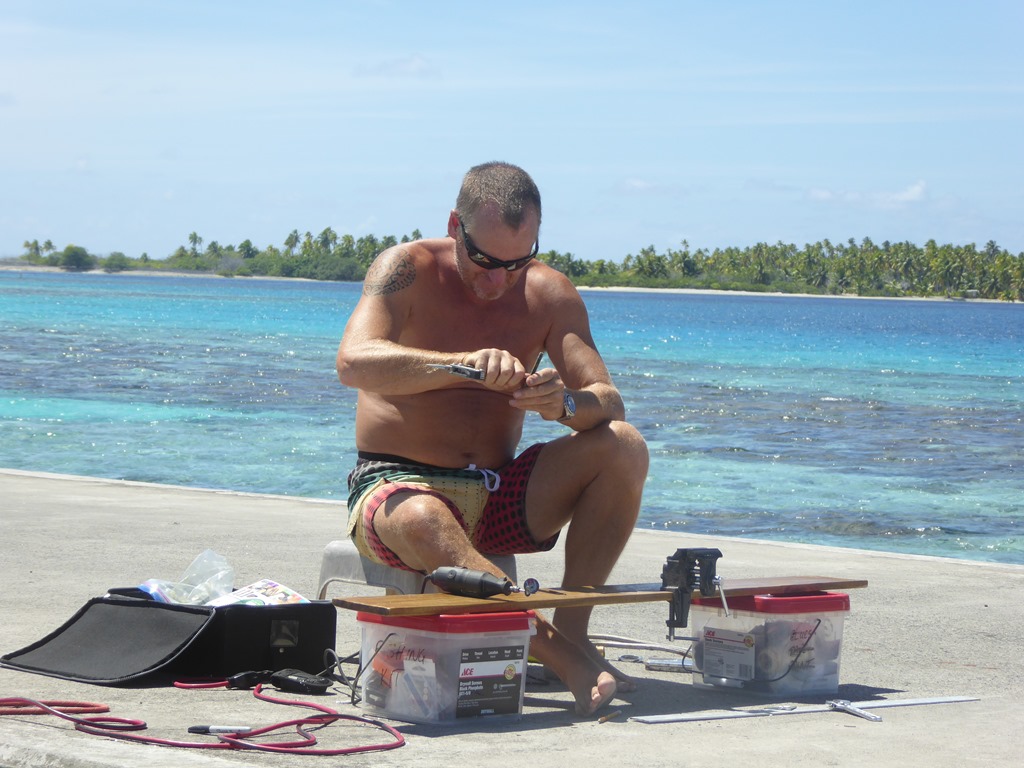
The official courtesy flag is French. We started with that then the Marquesas Island’s own. This is preferred by the locals. The only place I was able to find a small courtesy flag type within the Marquesas was at Nuka Hiva which we bought for 1000XFP. I think it would be an easy one to make up yourself if you had the time and inclination.

  P1040585

Note – When arriving in to the Marquesas, you have three days grace before you need report to the Gendarmerie. 

Customs. There are Customs here but very few people ever meet them as there is only one boat covering the whole of French Polynesia. You will not meet them as a matter of course on entry. The declaration paperwork you fill in at the Gendarmerie has a box for alcohol, tobacco, drug and firearms declarations. Fill it in accurately even if you are over your limit and use the term “Ships Stores”. The Gendarmerie simply want the box filled out and unless it is firearms related, they take no further action. If you have lots of undeclared booze on board and you do meet with the Customs Boat, expect them to take the view you are trying to sell it to the locals. You will be, at best, fined heavily, lose the booze and get kicked out of the country; worst case, they can impound your boat. If the booze is declared properly then the worst they can do is hit you with an import tax. However, I have yet to meet or hear of anyone this has happened to this season. “Ships Stores” seem to work.
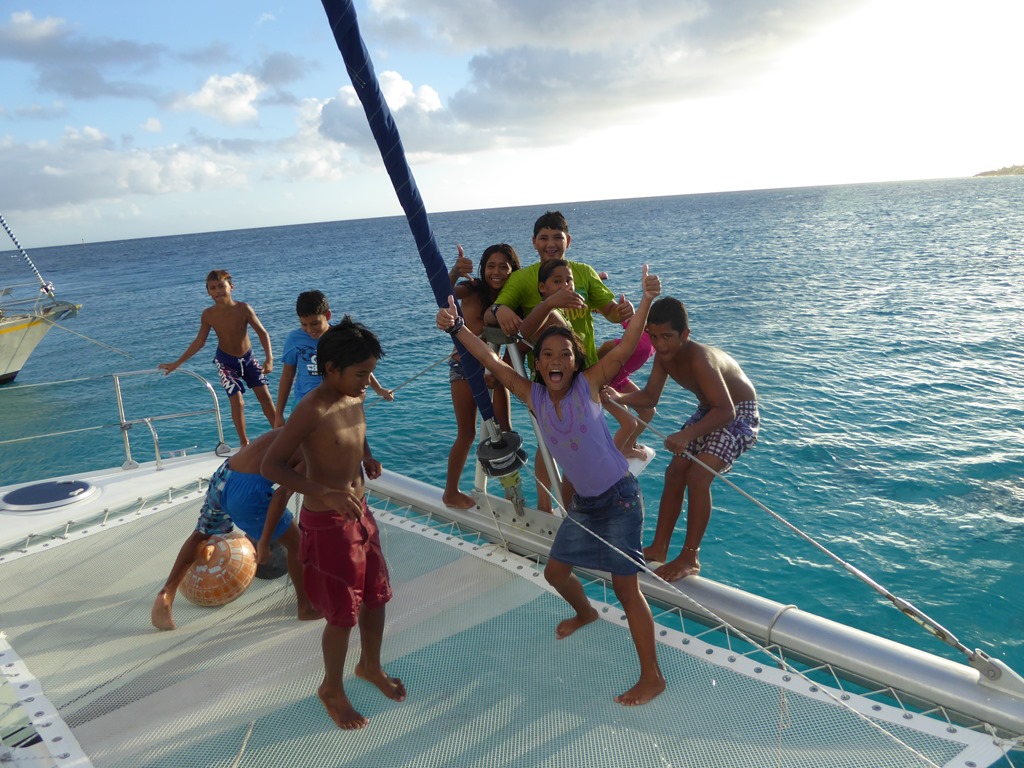
Agents. There are two that we know of in the Marquesas, both representatives of a Tahitian firm that if you planned well ahead, you could probably deal with directly. Sandra works in Hiva Oa, Kevin is at Nuka Hiva. A warning on Sandra. We twice failed to get a tax free fuel certificate from Sandra. We tried on our first visit to get one organised but the lead time Sandra gave us of “maybe one week” was too long. On our second visit, having tried to track her down for four days with missed appointments and no shows, we eventually managed to catch her on Bastille Day, getting the promise of the certificate two days later. Sadly when we met to collect it (she turned up 45 minutes late), she informed us that one document had been difficult to read and we needed to give it to her again. Asked when she had known this she said the morning of the day before. She simply smiled and shrugged when I asked her why she hadn’t phoned straight away to get the problem fixed. Asked when we would now get the certificate, she said maybe Wednesday, a further 5 days ahead – a total of 10 days from start to finish of process. It takes 30 minutes in Tahiti. The woman is singularly useless, difficult to track down and very unreliable. It doesn’t even seem to be an island time problem; just uncaring laziness. This is not just our experience. We have had horror stories from a number of other boats we have met. From those that we have spoken to who have contracted her, they often wait for several days after they arrived for contact to be made and often are made to wait for her to complete clearances. Five days was the longest we heard about. I think the worst we heard was from Dragonbane who used her for laundry. They got back a wet but unwashed and slightly smelly pile with a comment that she hadn’t had time to finish it. Not professional.

I’d strongly suggest if anyone does need an agent in the Marquesas, try Kevin up at Nuka Hiva. He, says people that have used him, can be relied on to communicate with you, can be used as a postal address, can talk boat parts and will help source too if you need stuff sent in from Tahiti.

Vincent, who started the new yard in Hiva Oa this year (2016) is looking into providing an agent’s service too. It may be worth checking in with him to see if he is offering the service in competition to Sandra.

Haul out Facilities. You hope you won’t run into problems on your crossing. However, some do and we were one of them. The new haul out and yard services at Atuana, Hiva Oa saved us a world of hurt and our ability to tour FP effectively. Please read our separate blog post on our experience with the yard. A link is HERE.

Pets. For those that have pets on board, French Polynesia is not an accommodating place. Unless you are willing to wait through a six month quarantine and pay the high fees for this, pets are not allowed on shore.   It doesn’t get any easier as you head out of FP West either so think long and hard to see if you are happy never being able to let your pet off the boat.

Stocking up. We have been very pleasantly surprised at what we have been able to source at a reasonable price. France still subsidizes food here and the import of good French cheese, pates and fixed price bread at 50cents a baguette has been wonderful. There is good shopping on Hiva Oa, Ua Poa and Nuka Hiva, each with at least two supermarkets with some variation of choice.

Fruit and Veg – You need to get in quickly after the boat gets in which happens every couple of weeks. The best stuff goes quickly. Fruit can be easily had just wandering the countryside and if you can’t find it in the wild, you will pay little to a local for a great deal of local variety fruits. Apples are more expensive as they are shipped in. Other than a little bread fruit (for which you need to trade with a local for they aren’t in the shops), vegetables are shipped in and the selection is basic. Cabbage, potatoes, onions, carrots and occasionally leeks seem to be the basic stock. I was amazed to find Pak choy in the market by the pier in Nuka Hiva one day.  God knows where it had come from.

Meat – All meats are frozen, are expensive but the quality is reasonable with most sourced from New Zealand. The sausages (proper French ones with a high meat content) are very good value and we have stocked up heavily on them.

Bizarrely, most sea foods are routinely imported and are expensive. Fresh fish can be difficult to find. Ask at the pier, not in the store.

Watch out for red label price tagged goods. If you see a red label, it means the product is subsidised and no import tax has been paid on it. Generally at least one red label item can be found for each product group. Red Label President butter is cheaper here than it is in the UK……

We ran out of Heinz Baked Beans a long, long time ago. However, we found the best substitute we ever have here in the shape of Libby’s Pork and Beans. And it is a red label good!!! No corn syrup present and 220XFP a big can. Eleanor and I are in heaven even if I am made to sleep “elsewhere” the night after eating them.

All Chinese goods are very cheap. Don’t bother with soy sauce, Greg! I suspect they are massively subsidised by the Chinese who are working hard on the Marquesians, trying to get them to accept the offer of fast internet for fishing rights around the islands.

Household cleaning products are expensive and there is a basic choice of most items. For those wanting to do ammonia clothes washing, strongly recommended if you want to save water, stock up in Panama. You won’t find any here.

Alcohol. Wow. So expensive. Prices here are $US for ease. A can of beer is $3-3.50.  The local gut rot rum is $25 a 70cl bottle. Famous Grouse (a basic whisky) – $70. Gin – $60-80. Wine – starts at $15 bottle and goes rapidly up. What you’d pay $10  for in the UK is $30+ here.

Mixers are very dear and are very limited in choice. Can of coke or anything fizzy – $2.  Make sure you stock up well before you reach here. 

Communications. Due to the distances involved and the huge hills of the islands blocking signals, VHF does not work well. HF is very popular and we have used the morning check in on the South Pacific Magellan Net, run from Tahiti, to keep up with friends, ask questions about the islands and to let the net know where we are. We have heard people reporting in on route to New Zealand on the other side of Niue, more than 2000miles away. We use the evening net only if we are doing overnight passages.

South Pacific Magellan Net             8.173MHz @ 1730UTC (am net) and  0400UTC (pm net)

For those wanting some BBC or English language radio. If you can, get a copy of the Sony Wave Handbook. It lists all frequencies and times of transmission from all the national HF stations in the world. Ones I listen to:

BBC Word Service                                6.195MHz from 2300-0700hrs local – best around midnight. Best for international news.

Radio Australia                                     9.580MHz from 2200 – 0930hrs local – excellent service in the morning hours. Good discussion and topic programmes. News from ABC News, largely Aus focused.

Internet isn’t the best in the Marquesas and it is expensive but you should be able to find service on all the islands. The roaming internet is provided by Vinispot or Manospot, with a few and regularly out of service hotspots. There is a map showing antenna locations in the islands on their website. Scratch cards are available at the Post Office at 480XFP for one hour or 2000XFP for five hours. For the best service, you need to find a Post Office and sit outside it. There are internet cafes on Hiva Oa and Nuka Hiva  only and the normal price is 500XFP for the password. There is free internet at the Library on Ua Poa.  The hotspot in The Bay of Virgins, Fatu Hiva is providing us with the best internet connectivity by far but only when it is working, which is rarely.

Phone cards are available from the Post Office. Phone calls within FP are cheap and are all the same rate, no matter what atoll you call, great for organising ahead. The only issue we have is cards last only 15 days before becoming invalid so buy the smallest value cards you can at a time so you don’t waste money. We keep one as spare for that just in case moment.

Data is expensive and whilst we looked at getting a data card, decided we would stick to the internet cards instead. You need to have a long term contract to make it worthwhile.

Money and trading. The local currency is the XFP and it is pegged to the Dollar rather than the Euro. As of Jul 16, exchange is about 110XFP to $1.  You will have great difficulty getting this currency outside French Polynesia. There are ATMs on Hiva Oa, Nuka Hiva and Ua Poa. To the amazement of USA citizens, dollars are rarely welcome here. The locals do not want the bother and expense of changing currency. Credit cards are accepted in some of the supermarkets, in a couple of restaurants and that is all. Check to make sure they take cards before you sit down or start shopping.

On Fatu Hiva, the locals are most willing to trade which is good as it is very unlikely that you will have local cash if you go there directly. Items greatly valued include:

Perfume, lipstick, hand cream, pretty much any female cosmetic (the choices here in the stores are very very basic), fishing gear, rope, dresses, kids clothing and shoes, T-shirts, .22’ cartridges (Fatu Hiva especially). Items commemorating your home country are said to be popular too.  They aren’t very interested in cast offs. New products if you can for clothes.

Cosmetic tester bottles would be a good trade item (and a good size) if you can get your hands on them.

NOTE – if you are going in to the Tuamotus, there is one island only with an ATM – Rangiroa. Expect to require cash so load up in the Marquesas before you leave. 

Fuel and Gas.  Fuel is available at Hiva Oa and Nuka Hiva. In Hiva Oa, it is from the gas station and you need to use jerry cans. In Nuka Hiva, better equipped for big ships, it is possible to tie along side the main dock and pump in there. Note tax free fuel is only available with a tax free certificate which will cost $130 (2016). It is valid for six months. It is worth getting if you are going to buy more than 55 gals in that time. They are available via the agents only and take some days to organise so plan ahead. My advice is to use Kevin on Nuka Hiva. He is more trustworthy and efficient. Current fuel cost is  130XFP per litre diesel and around 110XFP a litre for petrol. The tax free rate is about half of that. You need to supply the agent with a copy of your clearance paperwork, boat papers and a copy of your passport.

Gas is only available in European fit 30lb bottles. If you use US bottles as we do, you can make you own gravity feed hose easily enough but you do need to bring a spare US adaptor to build one. You need to buy this before you reach Panama. A photo says a thousand words…  Increase the length of pipe to get a better pressure flow. We borrowed the one in the photo and it worked after a fashion. Second time around we increased the drop height between the two bottles to 10’ and this worked far more effectively. A small set of digital scales to allow you to measure the weight of the bottles is an excellent idea and will stop you overfilling the bottles, which is dangerous in this heat. Gas is very cheap and a 30lb bottle is 3000XFP deposit and 2800XFP for a refill. Pick gas bottles up at a garage in Hiva Oa or Nuka Hiva.

P1020499

Laundry. You can get laundry done here but it is expensive. Cost at Hiva Oa was $4.50 per kg. $4 a kilo on Nuka Hiva. Both services were via the agents. They are no self service laundromats here! We washed our stuff ourselves on the pier using the free water . It dries quickly too.

Language. Polynesian and French are the two primary languages here. English, much as it is in France, is not common so get practising your French. The locals here are much more accommodating than in “real” France and will help you along with a smile as you try and explain yourself. Saying hello or thank you in Polynesian will get you a big grin.

Getting around. Taxis are rare. There is one for the whole of Hiva Oa and the only time we got in to that, he didn’t charge us anything in way of apologising for being away on holiday the week before with his wife when we were trying to find out her prices for laundry! Hitch hiking is accepted. If you stick out your thumb here, you are more than likely to picked up by a local, even more so if you have children or a woman in the group.

We hired a car, once, to explore Hiva Oa. Prices for a 4×4 Toyota Landcruiser will be around $100 per day and this price is common on all the islands. It is strongly recommended that you get a 4×4 (and know how to use 4×4 , hi and lo ratio)if you are going to explore. The roads out of town quickly become hard tracks and get steep. If it has been raining, you will need all the traction you can get. Mia and the Taranga crowd had an embarrassing night in the wild waiting for the road to dry up enough for them to move when on Nuka Hiva. They did say they got a good sunrise.

The Route to Take. We have loved all the islands. Each has its own considerable attractions and each demands a visit. The only advice I would give is, if you are going to push through the islands with a limited time schedule, to look seriously at what route you plan to take before you reach the islands. The winds rarely drop below the normal trade of 15-20kts and the seas have always been S of E, normally ESE. Trying to beat back to the southern islands from the northern group is hard work. We lucked out with our windless passage back from Ua Poa to Tahuata – the only windless 36hrs in more than two months but we had time to wait and explore more than most people will.

Doing this trip again, I would have arrived in at Fatu Hiva, then Hiva Oa, Tahuata, Ua Poa and finished at Nuka Hiva giving me the ability to stock up and refuel on the largest island of the group and a nice angle to reach down into the Tuamotus.

But it all depends what you want out of the islands and how long you have to explore. We wanted to go slow and enjoy the people and the culture. However, our favourite place, Hanamoenoa Bay on Tahuata had neither of these. But it did have Manta Rays, white sand and peace in abundance.

Whatever you choose to do, you will love it here. 

The Bay of Virgins, Fatu Hiva