All posts by stewart135

Some Cuba Information

Cuba Info

Rather than the normal “It’s wonderful” blog post, I was asked to do a dump on information that would be useful for those exploring Cuba.  I’ve tried to keep it at the big picture for folk and haven’t detailed individual casas or the alike. I dare say there will be other specific questions people may have. Just fire them in and I’ll try and help as best we can.
I’ll say now that the limited cruising information on the S coast is hearsay from those we met in the Marina as we chose to park up at Marina Santiago and explore Cuba by bus rather than lose Easting before our hike down to Panama. I can make no comment on the N coast or up towards Havana by sail. Take said information as you see fit.

One thing to note. Throughout Cuba we were treated more as guests rather than “bloody tourists”. The Cuban people may not have a lot of material possessions but they make up for it in pride in their country. Never be scared in asking for advice or help from one. They will, as we found on numerous occasions, go out of their way to help you. Maybe we just got lucky but I don’t think so. Great people.

Port of Entries

There are only 7 ports of entry and you must clear in at one of these before you do any further travel. They are Marina Santiago de Cuba, Puerto Vita, Cayo Coco, Varadero, Marina Hemingway, Cayo Levisa, Marina Cabo San Antonio, Cayo Largo and Cienfuegos

You must book in at one of these before you travel further.

Entry procedure

Noonsite gives you details of having to raise the Cuban Coastguard by radio at the 12mile line.  However, I’d emailed the Marina to tell them of our arrival and asked for direction.  What I got back was rather different.  Come straight in, calling the Marina directly on Ch72 three miles out, anchor at a designated lat/long and await medical clearance.
In the end, I decided to call the Coastguard as well on Ch16 but had no luck raising them over a period of several hours. I found out later that down by Santiago they don’t even have a radio and get the chat from the Harbour Master!

All marinas are manned 24/7 and you should talk with the Harbour Master ( a person of influence) as you approach.  Don’t just anchor up.  He will get upset and certainly here at Santiago, will direct you to move.  Note that all marinas are permanently staffed with Customs and Immigration officers.  If you annoy the Harbour Master, they will know about it.  Just saying………

We played nice and were directed to anchor 100m off the Marina.  Someone that didn’t play the game and ignored the gradually more annoyed Harbour Master calling them on Ch72, were directed to up anchor and to go to the formal anchor/check  point, a couple of miles away on the other side of the bay.  They got to wait a while before the doctor was sent out too.

The doctor came to the boat and we were asked a number of questions about the health of the crew.  No big deal. Temperatures were taken.  She inspected the boat including the cleanliness of the loos, happily giving advice out.  Having been in Cuba for a month and seeing the general standard of loos (few flushing, generally foul and rarely with seats), I’d now comment – bloody cheek!

Food stores were checked with particular interest in fresh veg and meats.  We had meats from Puerto Rico which were noted down.  This required a visit from another official to do a further inspection.  When queried, we were told they are more interested in meats coming in from DR and Haiti where they think potential infection may be carried from.  She also commented on a few rusty tins that we had in storage.  We assured her that we would eat them soon.

Once the doctor had left us (asking a “little gift” before she left – more on this later) we were moved to the dock to allow the Customs officials aboard.  Our passports were taken off us by the Immigration officer in a bit of concurrent activity whilst we were searched.
Although we were inspected and searched pretty comprehensively to the point of unworn short’s pockets being searched, it was done professionally and politely.  Only issue we had was when they found my 2nd passport (carried because of my previous business endeavours) but that was soon explained. The search took about 45 minutes.

We also had a drugs dog brought on board, the impact of it largely spoilt by the squeals of delight from Hannah as the dog came aboard.  It spent more time being petted than searching the yacht.

Immigration was easy and all the normal stuff.  Clearing papers from your previous country.  They are interested in where you have been in the last six months.  How long are you going to stay?  Where?  Travel intentions?  They loved it when I told them our vague plan then asked them for advice on improving it.  They got the map out to discuss options.  It took about 30 minutes and I left with four visas, permission for Lou and the kids to come ashore and some good information.

Visas are given in 30 day chunks.  I believe you can also get 90 day visas but from the chat in country, people found that getting extensions was easy.
Last “official” chat was with the Marina Harbour Master.

Key Rules

1. Dinghies to be used between your boat and the Marina dinghy dock or other foreign yachts only.  No exploring with them.  Tried to get an idea why on this and got “It’s just the rules”.
2. Cubans nationals may not, under any circumstance, visit your yacht.
3. No hand held GPS equipment may be taken off your yacht.  I didn’t like to tell him that even our compact camera has GPS these days, tagging each pictures with a location………….
4. And then the more normal ones on rubbish dumping, black water, oil and the rest.

My general comment here is all the staff we met during the entry are just doing their job, one which here is a significantly more comprehensive than other Caribbean countries.  You are probably going to be the only boat they will deal with in a day and they will do their job properly.  Go through it in good humour with them (Ernesto, take heed….!) and it all goes quickly.

Note that the Custom and Immigration officers are permanent fixtures at the Marina and do 24hr shifts.  Once you are alongside you will find that they are both helpful in information on local requirements and interested in you and your travels as well.  All of them are expecting that as the country opens, the “rules” are going to have to be relaxed and updated.  However, no one in any position of authority thought that this would be happening soon.

Money Gifts“.

Other than the doctor, sadly the very first person that we met in Cuba and in a position to cause you mischief (she signs off on food stuff inspection, med kit checks and alike), we have not been asked for money, other than a very few beggars.  Asking around the marina, all had been asked for a “gift” .  Most people gave her between $5-10US or equivilent. One boat that had $3 left, other than a $20 that they weren’t prepared to give her, were told that $3 was a poor offering and “surely” they had other currency.  We have had a quiet word with one of the Harbour Masters about it as most people are unhappy with her.

However, you will interact with a lot of Cubans who may ask if you have kids clothes, old shoes, fishing gear and the like.  They will asked for it in a no obligation way.  Up to you how you play this.  The odd t-shirt and fishing hooks were v gratefully received.  We will be staying in touch with one person who was very helpful to us.  Hopefully a parcel will get through to them in due course.

Money

This is a cash society.  Do not expect to be able to use your credit card for anything other than, perhaps, your westernised hotel. And check on that.
Cuba currently has two currencies.
CUC – Convertable peso. The foreigners’ currency. Currently 1.1CUC to 1 Euro.
CUP – Cuban Peso.  What locals use. 25CUP to 1 Euro.
If you are visiting any tourist site and any of the major cities, you will be expected to pay in CUC.  Tourist rates are completely different to local. E.g. The 30 minute ferry from the marina to city costs us 1 CUC per head.  The locals pay 1 CUP.

If you get out of the areas used to seeing tourists then you will sometimes be able to use CUP.  Most of these incidences for us involved buying street food from vendors.

DON’T BRING US DOLLARS!  The exchange rate has an 8% cost attached and then there is a further 10% penalty charge for using the great capitalist enemy’s currency.  Euros, UK Sterling and CA dollars are the preferred currencies.
I would suggest that to minimise ATM transaction costs, bring as much cash as you can.
There is a Cuban aspiration to combine the two currencies.  I don’t think it will happen soon.

Credit Cards and ATMs

Mastercard will only be accepted within a bank for cash withdrawal.  It will not work in any ATM nor be accepted in hotels.  American Express?  Not a chance.
Visa (both credit and debit) is accepted in ATMs and ours worked without incident.
Bank issued debit cards may or not be accepted.  Maestro cards, a fairly standard European type are not.
Note that the most cash you can withdraw in one transaction is 150CUC with a 4.50CUC charge on each transaction.  You can, however, leave the card in and make further withdrawals up to your own card daily limit.

Internet and Phones

Although there has been internet available in Cuba for some years at a very few internet cafes, Wifi is only just starting to make an appearance.  At time of writing (Feb 16), Trinidad has had Wifi available in the town square for four months, Havana and Santiago for about 18 months.  To use Wifi you are required to buy an access card from an ETECSA office, the communication provider for Cuba.  This means standing in a long queue.  The shortest time I queued was 45 mins.  Cards are available for periods of 30mins, 1hr and 5hrs. Price is 2CUC per hour.  The offices often run out of cards.  My advice is to buy a good stock when you get the chance.

Wifi hot spots are rare.  Trinidad has one which is the main square.  Santiago has one in the main square by the Cathedral and another at the ferry dock.  Havana has several as many of the larger tourist hotels have been equipped to act as one.  If you find the ETECSA office in a town, you are probably at the only place wifi may be available.  Data speed is reasonable but not fast.  Don’t expect to be able to upload large files.

Although Cuban phone sim cards are available, they are not available with a data package.  Foreign sim cards do get access to an EDGE service but the roaming rate is prohibitively expensive. Be very careful and check your rate before you think about using it.

Travelling around

By Sea – Anchoring and exploring the Cuban Coast

The “Rules” state that cruisers are only allowed to touch land at the port of entry locations, detailed above.  Crazily restricted and it is nearly as restrictive in real life.  You may also land at some designated tourist sites (Trinidad is one) but they are few in number.  You are allowed to anchor around the coast but the restrictions in landing on the mainland remain.  They don’t like you to drop your dinghy and explore, especially if you are on the mainland. Bit disappointing not being able to visit villages……. My advice, straight from an Immigration Officer is not to flout this.

To sail around the Cuban coast you need a Despacho from the Immigration Officer you booked in with.  On this you will need to have detailed each and every anchorage you want to use on your trip.  They will allow visits to the islands off the South coast where you are out of sight of land but for the rest, it seems to be at the grant of which ever Immigration officer you get.  The officers in Santiago were, I think, pretty on side and certainly a Danish boat in with us was surprised at how helpful their one was, to the point of suggesting pretty anchorages and snorkeling sites.  Have a good idea what you want to do and be prepared to discuss it with them in detail over a few days before you go firm with your final plan.

One thing to remember is that most Cuban officials don’t want to make a decision, particularly involving a tourist and the default setting is “no, you can’t”.  The other thing to remember is that your boat will be tracked by the Cubans and you will be asked why you went elsewhere if you try it on.  The in country security network they have is excellent……

By Land 

The main road linking the East and West of Cuba is a dual carriageway running only for the first few hundred km E out of Havana.  Thereafter the road changes to a single carriageway. The main roads running to major towns off this spinal corridor are again single carriageway.  These roads would equate to a poor A road in the UK.  Country side roads off the main roads are normally packed dirt only.  There are rarely road markings. There are more horse and carts using the roads than lorries and traffic is never heavy.
Cubans are safe and considerate drivers.  Due to the unaffordability of new cars or even replacement parts, they baby their vehicles.  They drive conservatively with big gaps and frequent use of the horn to make sure everyone knows where they are.  We have driven about in a 43 year old Lada, a 58 year old Plymouth and a Buick of the same era.  I won’t say any of them would pass a UK MOT (not even close) but they are still running because they are looked after carefully. Don’t expect seat belts.

Getting Around

Taxis – there are a few yellow cabs using Chinese imported cars, mainly in the cities.  Expensive, modern and they will have a meter (not always used) and seat belts.  Most cabs are older cars and all would be classed as classics.  Some of the Havana taxis are spectacular.  Pricing is a matter of discussion before you get into the cab and they are happy to bargain.  You’ll often have a few drivers competing for your business.  Use it to your advantage.  You can ask pricing for single trips but they are equally happy to discuss day tour pricing as well.
Don’t tip if you have agreed a price.  It is not necessary.

Hire Cars – expensive.  Don’t expect anything more than a basic compact for about 60Euro a day.  We were told there are significant additional charges if you want to drop off at anywhere other than your original location.  However, with the ability to design your own trip and really go off the main bus and therefore tourist routes, if you can afford it and you are brave, a great way to look around.

Train – although we know one person who recommended taking the train up to Havana, even the locals we spoke to just smiled, shook their heads and directed us to get the bus instead.  The guide books say only for aficionados; I’ll concur.  Dirty, smelly, holes in the stained floor for a toilet and slow.

Buses – Note here that there are few buses travelling between the cities and you need to book your ticket ahead.  We got caught out in Trinidad, ending up spending an extra couple of days there before we could get on a bus going back to Santiago.  Book either at the Omnibus Station or at a Cubancan office.  Pay in cash and you will need your passport.
There are three main bus companies.
The Omnibus (Viazul) is the government owned long distance intercity service covering the nation.  They use older Chinese buses but these are perfectly serviceable and the ones we were on had aircon.  This is the only bus service that charges 1/2 fare for a child.  Stops are made at bus stations in most towns so if you have time and want to explore the towns along the main routes, this is the service I’d recommend.
Cubanacan is the company you book either Transgaviota and Transtur tickets through.  These use newer buses and pick up from hotels only.  Their hub is Havana and you are able to use them to and from there only, with a few limited routes outside Havana, mainly tourist destination to destination.  Stops are made at their own posh cafes and restaurants which are well run but expensive. Check about lunch on longer trips (Santiago to Havana). It is generally included in the price.
All services stop regularly, generally no more than every 1.5 hrs.
For an idea of pricing from our trip.
Santiago – Havana. 17hrs. 51CUC per person. Lunch included
Havana – Vinales. 5hr. 16CUC per person
Vinales – Cienfuegos. 8hrs. 32CUC per person

Cienfuegos – Trinidad. 1 hr. 6CUC per head but we got a taxi for the same price. More fun going by a geriatric car with no seat belts and sounding if it was powered by a tractor engine!

Trinidad – Santiago. 12hrs. 33CUC per person

Scooters and bikes – Both were available for hire in the main towns. We used neither and can’t comment on pricing.

Accommodation

In the cities there are western hotels none of any great standard that I could see and pretty expensive.  Havana price is around 130CUC for a double room per night.
Our preferred accommodation were Casas, houses that Cubans have been given permission to rent out rooms.  It is a superb way to meet Cubans.  The accommodation is generally interesting and very clean.  One of the houses we stayed in had a 7m atrium and we slept on a bed which was 150yrs old.  The neighbour of another one we stayed at unfortunately had a cockerel that started every morning before 0300! All had very friendly families, happy to help us in advice on what to visit or do in their town.

Pricing for a night varies between 20 and 40CUC a night dependent on room size. It is a good idea to book ahead.  Vinales (pop around 1000), one of our stops, is very popular and frequently fills up.  Researching ahead also allows you to select casas with better recommendations.  Alternatively, if you don’t want to waste time searching for your next casa if you are not travelling to a set timetable, don’t be shy to ask for help from your hosting family in recommending or helping you find accommodation in your next port of call.  Many have friends and family that they can quickly arrange something with.

Remember internet is not widely available and you don’t want to waste time in searching for and booking casas when you have a city to explore.

Note that the Cuban government takes the vast majority of the room price you pay to the family.  The family make their money with you having breakfast and we were happy to support them by accepting the offer.  All charged 5CUC a head – well worth it – we were always stuffed when we left the table.

Most casas offer you dinner as well.  Price is normally about 8-12CUC a head for a three course meal, drinks extra.  We ate at two casas, both excellent meals, but we found that we preferred to eat out to enjoy the street atmosphere.

Restaurants will have a fairly standard fare (burgers, pizza, rice and bean dishes, pasta (limited but the seafood choices are excellent) Prices vary little between restaurants and you will normally be asked for between 8 and 15 CUC for a main.

Finding a Casa

Google Casa Particular and the government site will come up. Not great to navigate around but it covers the whole country. http://www.cubacasas.com
Another site is http://www.cnccuba.com
Many casa are now on Tripadvisor. Check their ratings.

There are also a few houses appearing on Air BNB. We didn’t use this resource.

Stocking up – Food, Booze etc – Before and During

Food in Cuba is difficult to find, limited in choice and expensive in the “supermarkets” there are.  Bread, eggs, dried beans and limited fruit and veg are generally findible but don’t expect anything fancy. Meat of any great quality is difficult to find – chicken is your best bet. If you are going to tour, try and stock up the boat before you come.

Once you have arrived, the boats in the marina found that if they kept the requirements simple, the best way not to get ripped off was to get a local to do a shop for you. Plenty of them are willing to help. They will be looking for a goodwill gesture in return. Eggs are wonderfully cheap. 2CUC for 30, about a quarter of what we are paying here in Jamaica currently. Chicken is cheap too but don’t expect it to arrive in anything other than a bloody plastic bag.

You will be advised off street food by the various officials at the Marinas and told to stick to restaurants.  We used the same rules as for the rest of the Caribbean.  If there is a pile of locals buying from a stall, the food is probably good enough for you. Seemed to work for us and you will pay in CUP rather than CUC.

Rum is cheap, filthy cheap. You can spend as little as 3CUC on a bottle of white rum (what they will use for drinks in bars) but be able to get a litre bottle of good sipping rum for 10CUC. I wish I had loaded up but I was being sensible. More fool me.

Best choices?

Top end. Havana Club 7yrs at 19CUC a litre – outstanding

Mid. Havana Club Especial at 10CUC a litre. – best value

Bottom. The base brown Havana Club at 5CUC a litre. Perfect for mixing

There are other brands of rum available occasionally but Havana Club you will find everywhere.

You will be offered cigars wherever you go and most of them will be fake. Think you can buy a box of Cohibas for 45CUC when they are 300+CUC in the official shop? Really??

The advice I got from a Canadian Havana resident was to buy direct from a farmer if I could (what is known as a Pura cigar) made by him from the tobacco he is allowed to keep. Farmers lose 90% of his crop to the government for officially  made cigars.

In Vinales, I paid 40CUC for 21 No4 equivalents in a simple cedar box which his family made that are simply superb. I got another 50 Panama size for 15CUC from a friendly local that were what he smoked. Still pretty good but nothing of the quality that I got at the farm.
El Yunque National Forest – PR

Puerto Rico is an island of high hills and with US foresight, a fantastic rain forest at the E end of the island, heavily protected for all the population to enjoy. Almost There, who had visited it before for very keen to take us there and show us the sights.

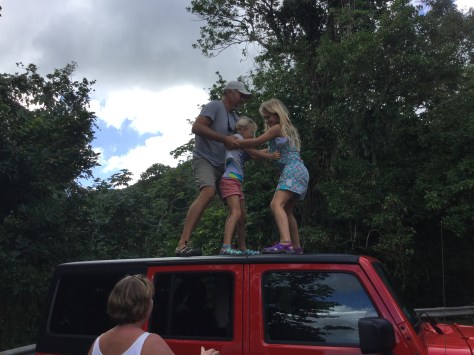
Having all clambered in to the Jeep (a bit crushed) we headed up the hills to explore. As we got up into the hills the views were spectacular, even more so from the jeep although trying to look at them proved difficult once Robert decided to dance.027

As you can see the kids got into the spirit of it!

023

We eventually reached the excellent visitor centre, high in the hills to find pleasantly, that there were no poisonous animals, snakes or spiders and wonderfully no mosquitoes in the forest. The only thing to watch out for is the occasional rabid racoon………..

There are a large number of waterfalls and walks available in the forest. In the end, we headed up to  La Mina Falls and work our way back down the hill.

La Mina Falls required a 30 minutes trek from the very, very busy parking lot, with an over enthusiastic ranger merrily improving everyone’s day by issuing tickets for anyone parking at the side of the road at a rapid rate of knots.

028.JPG

The trail wasn’t really. The area is filled with concrete pathways to limit the damage to the park and we passed lots of folk making their way back and forth to the falls but the stream we walked down beside was lovely. H forced the pace as she needed to get to the falls quickly. The speed she disrobed and shortly thereafter the look of relief was hilarious.

029
Relief

The falls were pleasant , little different than those we had visited on Dominica or elsewhere down island other than the numbers there. They were very overcrowded. Serves us right for going at a weekend. H found a friend to pull her closer to the falls. Small children who are confident and smile seem always to get a helping hand!

033034

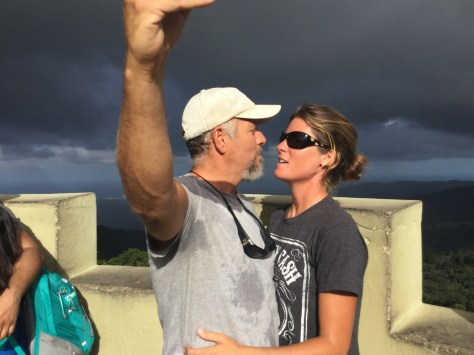
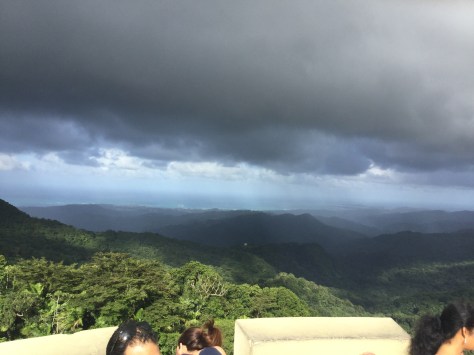
Heading back down the hill we stopped for some lunch at one of the street cafes – delicious – then headed for the Yokahu Tower. Once used by the Forest Rangers, it is now a great spot for tourists to look down towards the coast.

043
Robert and Shena enjoying the view?
040
The View from the tower. Look at those ugly clouds

Next stop down was the La Coca Falls. Just off the road, most folk just drive past. They are missing one of the best photo opportunities.  We all had fun trying to frame the best shots!

There are a number of longer walks within the park which would have been fun to do but we had no time to organise these. For anyone following us, I’d recommend a couple of days in the park midweek to get away from the crowds and perhaps to see a little more of trail than we did. A great place to explore and a great day out.


Frigate Bird Santuary – Barbuda

Identifying whether a frigate bird is baby, juvenile or adult is reasonably easy. A baby is white and fluffy, a juvenile is black with a white head, a male adult is black with a red chest and a female adult is black with a white chest. The wing span of an adult frigate is usually six to seven feet.
Attracting Females
To attract females, the males will puff up their red throats (they are called gular) with air by clicking their throats. They throw back their heads while doing it. It is extraordinary to watch them. I have noticed that they never fly with their chests fully inflated, the most they fly with is about a quarter of the full and it still looks like a struggle for them.
Growing up
Once hatched, it takes about five to six months for the babies to learn to fly and by then they will have developed a partially black body. Once two years old the frigate bird is an adult and they have now developed a red (or white) chest and full jet black body.
Migratory circle
Frigate birds from this sanctuary have flown as far north as Florida with tagged ones, and have gone as far south as Venezuela. These amazing birds have flown so far it is almost unbelievable.


Grenada – the Anchorages

We finally got to Grenada in mid July, six weeks after the start of the hurricane season. We had been watching the weather closely and with conditions being benign, we decided that we were safe to stay up island. We were always in a position to run the 100miles or so S well before any weather system could get to us.
We arrived to book in at St Georges, which has a good anchorage just outside the harbour entrance, which we stayed in for several days. We got the feel of the town and found a pretty good supermarket close by. Prices were reasonable in comparison to up island so the horror stories we had been told of super inflated prices was thankfully wrong.
There are many great anchorages on the S side of Grenada, all very well filled during the hurricane season. The main ones we thought about were Prickly Bay, Mount Hartmen Bay, aka Secret Harbour and Hog Island, all close together on the SW corner of the island. Prickly has the best access to services, Secret the best bar and social scene (including volleyball, played by myself three times a week) and Hogg island had the reputation of having the most kids boats in previous years. This year it was Secret Harbour with 20+ kids ranging from babe in arms (born over the summer).
However, whilst we were in St Georges we had discovered at the Grenada Yacht Club was going to have kids sailing lessons lasting two weeks which we quickly signed the kids up for. For ease of getting them the 30 minutes drive to St Georges we decided that Prickly Bay was our best option. We were glad to find that there were a good crowd of kids boats there too, a lot of whom we had met up island. We also signed up for membership of the University Club after getting a recommendation to do so from Tomas and Karin, a lovely couple, both vets, who are lecturers at the Uni. We had met them at Bequia. Whilst we used the club (a great pool and friendly bar) for most of the summer, next years cruisers will not be able to do so. The club has changed its membership requirements, now wanting a permenant address on the island – sailors are not welcome.
For our first period in Prickly, we parked up close to the Spice Island channel, right beside our good friends on Taia. Great holding, convenient to the local bus service and a short run in to the Prickly Bay Bar and its free internet. The downside is that you have little tidal movement, the Grenada Coast Guard in their fast ribs crashing though and if anyone believes that yachts in the bay don’t flush straight out rather than using holding tanks, they are a little naive. Heavy bottom growth is fast to appear in that nutruient rich environment! With most main anchorages in the Carribean serviced by an industrious soul with a pump out boat, normally offering water and diesel at the same time, I was amazed that no-one has set up that service for the several hundred boats parked up, just in these bays. All three bays would be a lot sweeter………
After we returned from a forray up to Tobago Cays (see seperate post) we decided that we would stay out at the edge of the Prickly Bay, off the University Club. This was very well sheltered (better than in the main bay area) with little or none of the prevelent easterly swell wrapping around the headland getting to us. Downside? With the water much cleaner, I had no excuse not to scrub Skylark clean of growth!
We also anchored in Clarks Court Bay, choosing to take the big boat around for a concert held there rather than dinghy the four miles. There was plenty of wind (always a good thing listening to the wind generator providing “free” power) and little fetch. Although there were a couple of small marinas there, there was little else to recommend the anchorage to us. It is difficult to get anywhere from there.
We travelled up to Gouyave on the NW of the island for their celebrated “Fish Friday” event. Great fun to do with a live steel drum band giving it laldy and some wonderful street food on offer. The anchorage itself is straight off the beach used by all the local fishermen. It has good enough holding but it is exposed and not an anchorage I’d want to stay at in poor weather. In a N wrap around swell, you would have an interesting time. You do have to keep a close eye out for the huge number of fish traps here.
We did have a few days in Secret Harbour after our haul out at Grenada Marine, which is another couple of hours E from Prickly. We did enjoy it there but in the end we enjoyed the University Club and its pool more. The 20 minute walk to get across to Secret was enjoyable exercise as well.
I think that we made a good choice in Prickly for our time in Grenada. It is certainly the most convenient to getting work done, exploring other areas of the island by bus and access to the shops. Its proximity to Secret Harbour was great….. but my liver probably suffered less abuse by being far enough away from it too!

Martinique (with a brief stop in St Lucia)

Next stop – St Lucia!  When the Thomas family first mentioned a potential visit, I had to do a very rough estimate as to where we may well be during May half term week.  At the time St Lucia seemed a pretty good bet.  However as we talked to more and more cruisers, it seemed that St Lucia was not as popular amongst the cruising community as one would have imagined.  This is due to various reasons, including aggressive boat boys, security concerns and, more worryingly, the murder of a yachstman on his boat at the beginning of 2014.  We decided not to hang around long.

We arrived in Rodney Bay in the early hours of the morning so sailed in as far as we dared in the dark before dropping anchor and getting our heads down.  The following morning we were up early and speaking to the marina – having not stayed in a marina since Nanny Cay, BVI in March, I was determined to make sure we had a full day to make the most of the facilities.  First stop – the pool!

The Thomases arrived safely and after lots of hugging and ‘haven’t you grown’ (for the kids, not us!!), we loaded them onto the boat.  It was like Christmas (again!) with presents and internet orders that I had asked them to bring out.   Following our night in the marina, we anchored in Rodney Bay for a night and then we decided to head north to Martinique, which turned out to be a great decision.

We anchored in Sainte-Anne so that we could book in.  It was a beautiful anchorage, with swimming and snorkelling opportunities for the kids.  The town itself was lovely; there were several restaurants, a couple of little supermarkets and, most importantly, a boulangerie!

The following day we decided to try the day anchorages to the south of the island.   We initially anchored at Anse Meunier and headed ashore.  Having explored onland a little and with the promise of showers, we motored further round to Grande Anse des Salines – we were the only boat in the bay.  Sadly the promised showers were shut as it was out of season but we did find an outdoor shower at the restaurant on the point, which we were not shy in making the most of!  The anchorages were beautiful and deserted – we can highly recommend them as a day trip from St Anne.

Following a quick exploration of the (somewhat limited) delights of Le Marin the following morning we decided to head north.  We sailed past Diamond Rock, which had interestingly been HMS Diamond Rock in 1803 due to its strategic location and a shortage of available Navy ships at the time.

Diamond Rock

We then anchored in Petite Anse d’Arlet for the night on the promise of some excellent snorkelling, which the kids made the most of while Janet and I lounged on the trampoline, slowly getting sunburnt.

Josephine, wife of Napoleon Bonaparte, had been born in Trois Ilets, on the south side of the bay from Fort de France, the island’s capital.  Tempted by a little history, we sailed round and anchored for lunch.  Sadly this is most definitely a department of France and our trip ashore to eat lunch out was a positive failure!  Everywhere was closed, with the exception of the boulangerie, whose sandwich fillings were limited to ham.  Unfortunately our luck did not improve in Fort de France, where we anchored that night – dinner was KFC!  We were not entirely enamoured with Fort de France so after Simon managed to buy their ferry tickets to St Lucia, we hot-footed it to Anse Mitan, a holiday village across the bay, which proved to be a much more favourable location.  I decided there and then that this was where we would be staying for Stewart’s trip to Dominica for the cricket.

It was an emotional farewell the following day as we said farewell to the Thomases and it was the first time that I had really felt homesick.  Fortunately it was short-lived as the following day our friends from Almost There, closely followed by Taia, arrived in the anchorage.  The girls also made friends with two little girls from S/V Lagom and happily decided that school was over early that day, swimming across at the earliest opportunity.

Stewart headed off for the cricket (more of that later!) and the girls and I enjoyed the time being stationary for a while, catching up on home-schooling, swimming and generally relaxing.

Martinique, being a French island, is well served by hypermarkets and European stores.  Not to miss out on yet another great provisioning opportunity, we hired a car, offloaded the children onto the menfolk, headed onshore and became women on a mission.  I was pretty excited to find a reasonably priced kayak at the Inter Sport (finally!) but with a small hire car, I needed to get rid of all the shopping plus my two friends before I could purchase it.  Speeding back round the dual carriageway in an attempt to make it back before closing time, I had not really thought the whole thing through.  Fortunately the store was still open ten minutes after closing time and I successfully made the purchase.  The security guard was particularly unhelpful and dumped the kayak outside the front door and left me to it.  Sadly the kayak was somewhat bigger than the hire car….. Mmm – great!  With the help of a friendly local with a pick up truck and a bungee, I managed to load the kayak into the back of the car.  The boot was carefully held down as I drove somewhat more sedately on the way home.

In 1902, the town of Sainte Pierre, the Paris of the West Indies,  was devastated by the eruption of the volcano, Mont Pelee.  Of the 30,000 inhabitants, only one survived – Auguste Ciparis, the sole occupant of the city’s dungeon.  After surviving four days in his cell, which was buried beneath layers of ash, his sentence (for assault) was suspended and he spent the rest of his days touring with the Barnum and Bailey Circus – as an exhibit in a replica of his prison cell.  Having seen Montserrat, we decided that climbing this infamous volcano was a must during our visit.  It was a great hike followed by a  tour of the island in search of somewhere for lunch.  Again we were completely stymied by French opening times – what is it with not being able to eat outside their set meal times!

We waved a sad farewell to Martinique, which had some of the best cruising waters that we had seen in a while.  Having sampled St Lucia briefly, we decided to completely bypass it on the way south again.  Taia accompanied us and we set out for an overnight sail to Bequia (also missing an equally unsecure St Vincent!).

Dominica

It was with excitement that we arrived into Dominica.  The island most friends put at the top of their favourite list.  Why?  Well, according to Spirit of Argo, the first island that you can properly shop in the local markets and stock up for $10 a week with fruit and veg.  To Ruffian, no corporate businesses.  To Shian, the best environmentally protected of islands with fantastic rain forests.  Downside, the first place we had to be careful in the selection of our boat boys and there are few beaches to enjoy.

We were met by Jerome (otherwise known as Cobra – the same Cobra who makes an appearance in the Doyle’s guide to the Windward Isles) a mile out from Plymouth Bay.  A quick explanation –

Boat Boys are individuals who will run around anchorages and harbours in speed boats, offering services to you.  They are common in the S of the Caribbean.  Everything from the “best mooring ball” to tours of the island, work on the boat, fruit, fish, laundry, water, diesel…. You name it; they’ll get it for you – at a price.  In most places they are unregulated and this can cause problems, fights even, as they tote or claim your future business.  It is common (St Lucia and St Vincent are said to be the worst) for the boat boys to be uncomfortably and aggressively in your face.

In Plymouth Bay, after some external advice that they were becoming too aggressive, driving away yachties, the boat boys came together, sorted their ways and formed a small collective.  The word got around quickly on the cruiser net that Plymouth was a good place to go again.

These days it is a very safe anchorage.  The boat boys run a security boat during the night and have run off any trouble makers there may have been.

With the Thomas family due in to St Lucia in a few days, we decided that we would spend all our remaining time before that in Dominica.  It proved to be a good decision.

Cobra was questioned closely and laundry was fired off with him.  Lou was very happy to find that it had been line dried rather than being roasted in a machine and at a reasonable price.  We also decided that we would take one of the tours he offered up the river at Plymouth.  The rest of the activities, we chose to sort ourselves.

Our trip up the river was fascinating.  Although Plymouth has by far and away the best anchorage on the island, the river and the swamp it runs out of, too big to drain, meant that the original capital based there, was moved to Roseau further down the coast.  Yellow fever and mosquitos were a major killer in colonial days.

There are strict laws enforcing the preservation of the natural habitat of the island so the journey up the river (of not more than a mile) is done by oar.  We had a good conversation with Cobra and going quietly means that you get to see a lot more fauna.  We saw the local version of the Kingfisher and several Crowned Heron on our journey as well as lots of huge crabs and shoals of mullet; the mangroves being a wonderful nursery for young fish.

We went up a side river to visit the filming site for Calypso’s House, used in the second and third Pirates of the Caribbean films.  The locals from Plymouth made up a lot of the extras for the scenes filmed there.  Johnny Depp was quite human and down to earth, according to Cobra.

We finished at a small plantation, walking out into a scene of tropical flowers and hummingbirds before wandering into a mix of mango, bay, pineapple, banana, passion fruit and cinnamon trees.  It was absolute heaven and the passionfruit juice was extremely refreshing.  We were presented with a bay sprig, now drying out in the girl’s bedroom.

To explore Dominica, you need a car.  Taxis, as always, are fiercely expensive so we hired a 4×4, visited the local police station for my Dominican license, which proved to be a receipt for the money I paid for the privilege, and headed off to explore.

The island is mountainous and the roads are a collection of endless switchbacks through the rain forests.  Thankfully there isn’t that much traffic and the locals, for once, actually drive carefully.

We visited a few of the sites the island had to offer including the Emerald Pool, Trafalgar Falls, the hot pools at Wotton Waven (great baths!) as well as the Fort which stands guarding the entrance of Plymouth Bay, walking up the hill to the top gun sights and a fantastic view N to S through W. Sadly we didn’t have time to stay to visit more nor stay for the Jazz concert due at the Fort on the following Saturday.

We also had a wander through Roseau. Small and chaotic, it also proved to be the site of one of the West Indies Test match cricket venues for the upcoming Australia tour.  I bought tickets for the first four days of the match (in the best stand) for a total of just over £20.  Try paying that at the Rose Bowl – you might get a couple of Pimms if you are lucky.

Note for future visitors – make sure you pay for the week Island visitor ticket rather than the single site ticket.  We only found out about the option when we visited our second site and had to pay up again, feeling a bit mugged.  Current cost per person? $5 for one; $8 for a week pass.

We left Dominica unsatisfied.  Although beaches are rare, the island interior with its hot springs, spectacular waterfalls and rainforest is beautiful.  The locals have done well to maintain its unique environment.  Long may that policy set continue.  We could have explored this island for weeks and the short period we have had has but wetted our appetite.

Another time………………………..

Guadeloupe

On the basis that we were going to spend time later in the trip in the other French island of Martinique, we had initially decided to cut short our time in Guadeloupe.  Perhaps this sounds a bit judgemental but we are running out of time to see all the places we’d really like to and still get S enough to be safe as the Hurricane Season (and wet season) nominally arrives at the start of Jun. So prioritising where we spend time is sadly necessary.

No plan survives contact with the enemy and unfortunately the enemy here proved to be Skylark’s port engine.

Our engines don’t get a lot of use. We have them on for anchoring and getting underway (must haves as our windlass needs engine power to power it – frankly a design flaw but nothing we can do about without replacing the damn thing) and little else. As we left Monserrat, we heard the scream of the engine alarm showing us overheating. We switched off and failed to find anything markedly wrong. Oil ok, coolant level seemingly ok, nothing gumming up the seawater intake and the filter was fine.

Coming in to Deshaies at the NW end of Guadeloupe we had 5 mins of engine before the engine alarm screamed again. We managed to anchor and on checking the engine again, this time it was obvious the coolant level was painfully low. We refilled and with Robert from Almost There acting as the engine guru tracked the leak to an outflow pipe from the coolant tank to the engine. The tank had slipped, allowing the pipe to touch the belt (another rubbish design) and the belt had eaten through the pipe, just enough for a very slow drain of the coolant.

One advantage of being in Guadeloupe is it is the home of Volvo for the Caribbean. We decided to stay and make the most of the island for the day, hired a car and then drove across to the capital, Pointe-a- Pitre. I got to go and be frustrated by the lack of correct part and Robert at the cost of some dive equipment. I had a conversation in my pigeon French with the Volvo engineer, mainly drawing pictures of possible solutions with a lot of questioning raised eyebrows which led me to take another pipe part with a cutting suggestion. Not the perfect solution but one that will do us (hopefully) until I can get the right part ordered from Europe.

On the way back across, we failed miserably to find a field that we could surreptitiously nick some more sugar cane but did find the Rum Museum which combined its attractions with a fantastic collection of dead bugs and model boats through the ages.  Have to admit although the mix sounds pretty messed up it was an excellent afternoon’s entertainment and the kids loved it.  The grown ups enjoyed a selection of straight and flavoured rums. The model boats allowed a reaffirmation of the explorer work we had been doing with the girls; Sir Francis Drake and Columbus’s ships both in the collection.

After managing to cut the replacement tube to size and refill the coolant tank, we moved on to the one place we did want to stop at in Guadeloupe which was Pigeon or Jack Cousteau Island. This island, half way down the W side of the island is a famous dive sight. We anchored on the Guadeloupe shore, about a mile from the island and dinghied out. Having been protected for a long time the wildlife around it is fantastic. Although it is better dived rather than snorkelled as it is all pretty deep , the coral where we swam in 20-40’ of water was excellent with plenty of fish. Friends that have dived it down to about 70′ say that whilst you need to be careful in the currents that run up the side of the island, it is one of the best sites they have dived in the whole of the Caribbean – no mean praise. My thanks go to the young French couple who saw my dive knife fall out of its holster and recovered it for me.

Having had a great day at the island, we left Guadeloupe in the dark for an overnight sail down to our next port of call, Dominica.

We didn’t do Guadeloupe justice at all, I fear. It looked good, the French influence was very obvious and we enjoyed the short time we were here. If we had more time it would have been good to have a proper explore of the island. As it was we missed completely the islands of the S coast, which were on our really want to see list.

The island is definitely somewhere to revisit when we next pass through this way. In a few more years……

Montserrat

Sailing down to Montserrat proved to be slightly annoying. Having announced that we should have at the worst a close reach, we ended up being close hauled all the way down as the wind wandered into the ESE for our crossing. The saving grace were the seas running in from the ENE so we made pretty good time and went over the waves rather than into them.

We realised that we were downwind of the volcano only after a typical Henderson argument on who hadn’t owned up to dropping one. We were 15 miles offshore and the sulphurous stink was strong!

Sailing up the island, the damage caused by the latest round of volcanic eruptions which started in 1997 is painfully obvious. Plymouth the old capital city was laid waste and is largely covered by the ash.  A few buildings poke out here and there. The only part of the city which is still in operation is the jetty at the port which, ironically is used to load the ships taking away the island only export, the ash, for building and agricultural use.

We anchored at Little Bay at the N end of the island. This is where the new capital city is planned although there is little evidence of it other than a posh new administration building sitting by itself up a one way street. Having booked in, an easy process, we met a wonderful lady acting as the security guard for the port. We asked her about car hire on the island (yet again taxi prices here being very expensive) and she spent an hour phoning around before finding us a car. Great service!

We drove down to the Montserrat Volcano Observatory and lucked out. It was both open and one of resident volcanologist’s was there. Small world moment – he turned out to be from Haddington – a whole 5 miles from where my folks live now – which led to us getting a longer chat from him than I think most would get. The 40mins video they show at the MVO was informative but could do with a refresh. A bit washed out.

We left the MVO with directions to hill top sites which gets you closest to the volcano. Montserrat still has a large exclusion zone with a line dividing the island about 1/2 of the way down, the southern half being out of bounds. Montserrat’s saving grace is the trade winds run SE-NW and it is very rare that any fallout would ever hit the N end of the island.

With no road signs, we had a bit of an explore to find our first hill top and drove aimlessly around, occasionally coming up to signs with “Forbidden Zone” on them. Thankfully a local felt sorry for us and kindly led us to the start of the hill across what was an 8m deep ash river – not surprised our map was inaccurate.

Garibaldi Hill gave us a good view over Plymouth. The size of some of the boulders thrown miles from the crater were staggering. They were bigger than good sized houses. We drove around to the other side of the island to where the old airport had been and on to Jack Boy Hill. We had a wander up the nature trail there but quickly realised that we didn’t have the time or water to do even a small part of it.

We kept the van and revisited the route we did on day one with Almost There who arrived 24hrs after us. We also stopped at the road side café recommended to make the best Goat Water, the Montserrat national dish. We ate in front of a colourful building. Kingsley’s look of horror when she read exactly what the building was for was priceless.

We also enlivened our trip by finding what we thought was a posh hotel (shown on the map as a historic building) which turned out to be a private house of a very annoyed  and gobby American who threatened to turn the dogs lose on us. We departed swiftly.

On Jack Boy Hill, we met a very tired looking Matthew Paris finishing the trail we had looked at the day before. We had a quick chat in passing. He was there to recover from the election campaign. Not sure if had envisioned hacking up and down parts of a volcano in 90 degrees of heat as part of his recovery plan!

Two days in Montserrat was enough for us. There is little to do there other than the activities around the volcano and for all of them you need a car which, even at the knock down rate of $40 a day soon adds up. Saying that, remembering what the volcanologist told us, whilst the traditional markers for an eruption aren’t been seen although the top of the current volcano is larger than the 1995 height, perhaps soon someone will work out why the SO2 output of the volcano is currently running at 200 times its normal…..

On to Guadeloupe.

St Kitts and Nevis (and a surprising UTR’s moment)

This point on our travels marks the change from upwind sailing to being able to get for much of the time a wind on the beam, making life far more pleasant on board.  Although we still have to get out to Guadalupe via Monserrat, there should be enough S in our course to hopefully give us a close reach rather than the tight on the wind thump we have sadly been used to.

Although we thought about going across to St Eustatius, we decided that putting a couple of days into the timetable when we knew we were cutting things fine to get down in reasonable order to St Lucia to pick up the Thomas’s (our next boatload of friends visiting from the UK), might cause us dramas later on down on our travels.

The sail down to St Kitts from St Barths on a course of about 190 Magnetic  was wonderful. Not being thumped by the waves meant that we left a little too much sail up but rather than lumping along at 5knts, we touched double digits at times. Exhilarating, fun and we even saw a slightly smug smile on Lou’s face as we went past a 60ft ketch going the same way as us.

We screamed down to the gap between the N end of St Kitts and St Eustatius before we got into the wind shadow of St Kitts. We had a slow sail down the side of the island to Basseterre, the capital. The island had far more obvious organised agriculture than anywhere else we had seen so far with large numbers of old chimneys sticking up. These we found out, marked different sugar plantations processing plants, dating back to the 1700s, the plantations covering a large proportion of the island for a long, long time.

We parked up, the only yacht in a very rolly bay, to allow us to book in. After wandering around to find the immigration office (tucked away at the awful cruise ship terminal with its obligatory “genuine” island product shops), we had a quick stop in town, finding a very good museum covering the history of the island. School done we headed back to the boat and were pleasantly surprised to get a call from our friends on Almost There.

We found ourselves parked up beside them in a partly built marina in the Great Salt Pond at the S end of the island, part of a huge complex being built there. It was obvious yachties were not the normal clientele. Used to having only superyachts, they let Almost There in on the basis that Robert gave them his @ Youngblood aviation.com address (yes, he did own his own sizable airport…). I think they were hopeful he might buy one of the lots! We got to tie up on the basis of being his special friends. Saying that, they didn’t bother giving me the glossy brochure he received once they had seen Skylark. Not quite superyacht status…….

Whilst the facilities at the marina were minimal, the clubhouse that we got free use of was pretty special. At only $400k membership fee, it is probably out of our price range when we finish sailing but we thoroughly enjoyed it whilst we were there. I think that the staff rather enjoyed the kids being around as well.  As the club was pretty quiet, they may have just been a bit bored but it meant the kids and ladies got looked after royally.

Almost There had hired a car but we upgraded it to a van to allow us all to tour the island. The three things we really fancied seeing were a zip line course, the Botanic Gardens  and the fort that looked so impressive as we had sailed down the coast to Basseterre.   Sadly the zip line course, much to the kids disappointment, was closed and it was the wrong time of year to see the Botanics (wet season the best time). However from the zip line camp, we followed the road up the hill on a pretty rough track (hire care= someone else’s problem….) getting some great views looking N up the coast before being attacked by a couple of dogs guarding a small field of cannabis plants. After going a bit higher, we turned round when we thought that we would pull out the suspension.

Fort George (https://en.wikipedia.org/wiki/Brimstone_Hill_Fortress_National_Park )  was a bit special and is a UNESCO World Heritage site. Having had several years at Fort George just outside Inverness, I was surprised at the amount of similarities I could see in the design. I was even more surprised to find the Royal Scots (the Royal Regiment) crest up in the military part of the small museum that the Fort had.   It turns out that the Regiment formed the infantry contingent of the Fort’s population when the French invaded the island in 1792 and having fought the French to a standstill although hugely outnumbered, were allowed to march out bearing arms. The island still marks the occasion as the most significant battle the island saw. Up the Royals!

We went right round the island, stopping for some great and cheap food at the street cafés which are common here. We also stopped on a farm track and cut a few sugar cane. Cue sounds of crunching and quiet children!

After being joined briefly by Taia who had caught up with us from St Barths, we decided to move on quickly to Nevis.   Nevis is very different to St Kitts. Whilst St Kitts has embraced the arrival of the big cruise ships, Nevis voted against their arrival. The island is far quieter and is reliant on one big Four Seasons hotel for a large part of its islands tourist income and island employment. It employs up to 2000 staff during the high season, a sixth of the island’s total population and maintains, by agreement with the island a minimum staff of 800 during the off season.

The island is volcanic. We had heard about the hot spring baths in the main town of Charlestown and we went up mob handed to try them. After we minced around (lots of expressions of “damn, it’s hot) we were shown by a local how you should get in which is to man up, get in quick then not move! Once you were in, it did feel good. In the end, even the kids managed a dip.

We went on to the Nelson Museum, just up the hill from the Baths. Lord Nelson’s wife, Fanny (https://en.wikipedia.org/wiki/Frances_Nelson )was from Nevis. They met whilst he was stationed in the Caribbean early in his career and the island commemorates this by having a good exhibition on him. It is worth a look.

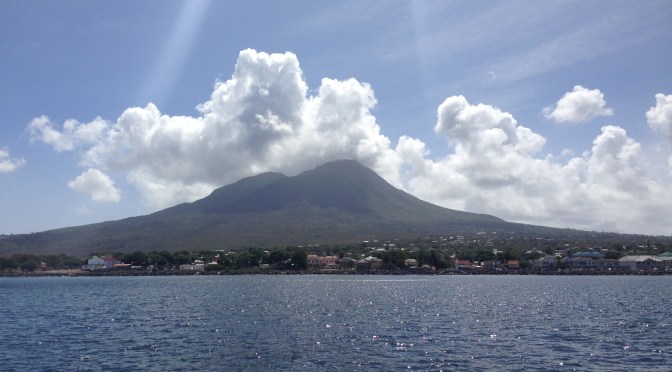
Almost There, having climbed the volcano at St Eustatius, was keen to try the same thing at Nevis. We got a bus around to what we suspected was a starting point and walked up a reasonably well defined path towards the major water source coming off the mountain. Further on, it got a bit cheeky and as we got up the hill, the vegetation turned into proper jungle. Spectacular, sweaty and quite hard going for the really smalls, Hannah and Matias, who both scrambled very well. In the end, we stopped just under the river source about 2/3 up the mountain, had a bit of fun roping down into the river bed with the rope Robert had carried up and padded in some rather nice and cooling pools.  We invaded a very nice resort on our way down and illicitly used their pool to cool of in. A nice way to finish a good walk.

Back in Charlestown, we found another museum, a tiny affair devoted to sports (read cricket) personalities of the island. We had great fun taking Ernesto and Natalia in and trying to educate them in the rules of cricket. I fear we failed to impress them!

After another day anchored off Charlestown and a last dip at the baths, we decided that we needed to see an active volcano, that of Monserrat the next island down and so planned the move on. Whilst St Kitts had been impressive for Fort George, I’d have to say that I enjoyed the hospitality and friendliness of the Nevis locals more. I’d have loved to have been able to spend more time here.   Next time…….

St Barts

After nearly a month on the hook in St Martin, it was with itchy feet that we hoisted sails and headed for the small island of St Barts.  Our first stop was anchoring off the uninhabited Ile Fourchue, a marine park that lies between St Martin and St Barts.  It was originally home to a group of goats but they literally ate themselves out of house and home and the small number that survived were removed from the island.  Vegetation is slowly returning….

We went ashore to explore and take in some of the great views from the various high points, whilst trying to stop the kids throwing themselves off.  It was a welcome hike following our sail.  The next morning we snorkelled off one of the points in the bay.  The snorkelling was pretty good but not the best we have seen, by far.  I think the high point for Stewart was the number of very large barracuda lurking right on the point.

The next morning we sailed down to Anse de Colombier at the north end of St Barts.  It is a pretty little bay and beach within the marine reserve with no road access but a short hike around the coast will get you to civilisation.  And boy was it civilised!  The beach at Flamands was surrounded by exclusive hotels with guests enjoying the golden sand from beautiful white sunlongers.  We were enjoying it too, but at a fraction of the cost.  Having asked directions to the main street, we were directed through one of the afore-mentioned posh hotels, the White Horse. The kids had a sneaky foot dip in the infinity pool to get rid of the sand.  I was considering disowning them but managed to get them out in time for the concierge not to see them.

It was decided that we would attempt another field trip (following our unsuccessful trip to the museum in St Martin) so we headed into Gustavia to look at Forts and museums for the day.  While Stewart and Ernesto drooled over a very posh racing yacht, called Nomad IV (http://www.yachtcharterfleet.com/luxury-charter-yacht-47466/nomad-iv.htm ) that was in port, we popped into the Tourist Office to check out entry details for the fort.  Alas we failed at step one – the fort is actually the Gendarmerie and the other two forts that were displayed on the map are not actually forts.  Not to be defeated, we headed round town to take in the historical points of interest.  We managed to finally drag Stewart and Ernesto away from Nomad IV after they decided that she would be FAR too uncomfortable as a cruising yacht as she was rolling like a pig.  I don’t know, I reckon I would have been able to make myself at home.  Our frustrations were not over.  We finally made it to the museum only to find that it was closed for the day, for no apparent reason.  Not an entirely successful field trip but the kids did learn a fair amount about the history and we had a very nice lunch at the popular ‘Le Select’ restaurant, which seems to be a popular spot for yachties.

Gustavia is a very well maintained, pretty port and town but the entry fees are set so as not to encourage sailors to hang around too long.  We had a lovely few days and I would certainly like to come back, either on a yacht or a nice hotel (if we ever win the lottery!).